Sunday, September 27, 2015

Moses the Lawgiver

[The following is Episode 5 of my 16-part documentary series entitled Larger than Life, about the role that beliefs play in shaping the events of our civilization.]

                Long ago, when Agamemnon and his armies fought against the powerful city of Troy, the exploits of the Greek warriors were preserved in verses that were memorized and recited to later generations, among peoples who had no other connection to this ancient time.  To these later peoples, the tales provided a context for their lives, a history, a connection to the gods, and a common heritage.  The tales found expression in poetry, and song, and in a new medium unlike anything the world had seen before, the theater, in the plays of Aeschylus, Euripides, and Sophocles.  But before the walls of Troy fell, another great conflict, playing itself out in the land of Egypt, would be immortalized in the writings, songs, and verses of distant generations, centuries removed.    The outcome of this drama would also create a context for living, a heritage, and a connection to one, special god, who would assume a role in our civilization unlike any before or since.  The drama was a slave revolt, the outcome, freedom, and its hero, a man named Moses.


            In the first four episodes of this series, “Larger than Life”, we have looked at the earliest civilizations, in Sumer, Egypt, Crete, and Greece, and at some of the myths that gave their peoples a sense of meaning and common destiny in their lives.  It was easy to listen to these with amusement, fascination, and even a little condescension, but now, in Episode 5, as we turn our attention to the Hebrews, we are crossing the threshold into what might be a little less comfortable territory.  It will not be as easy to be so detached, or so impartial, or so bemused, as we listen to some of the stories that many of us still teach to our children for religious inspiration, or as we talk about that God of the Hebrews which is the same one that many if not most in our society pray to today.  Like the legendary ether that physicists once believed surrounded us, an invisible substance that serves as a medium for light waves to travel through, the religious traditions of the Bible permeate our culture, and we are immersed in them.  It is difficult – it might even be impossible – for us to step out of them and examine them with an impartial eye.  Even those who claim to be free of our religious traditions often demonstrate by their ill-disguised hostility toward anything religious that they are not really free of them at all.  As we discovered at the end of the last episode, it is true that many of our ideas about reality, about truth, and about morality have been passed down to us by the ancient Greeks.  But people tend to be much more sensitive talking about their religious views than their philosophical ones.  That’s what makes this a touchy subject, but also a fascinating one, and an important one, if we wish to learn how our beliefs shape our destiny.  Who is this God of the ancient Hebrews that holds such power over our lives, how did we find Him, or, perhaps it should be asked, how did He find us?

            The story of the Hebrew God is preserved for us in a collection of books that comprise the Jewish Tanakh, and Christian Old Testament.  This Bible, as we know it, offers us a complete history of our existence, from the time that its god created the world, through its own version of the flood legend, and on through the rise and fall of many empires.  Now as a history of the world, it presents us problems even in the opening chapters.  As Clarence Darrow, in the famous Scopes Monkey Trial, pointed out, the biblical account of the beginnings of humanity runs into difficulties almost immediately, with the story of Cain, the first child of Adam and Eve, who leaves his family, settles in the land of Nod, and takes a wife.  One is compelled to ask, as Clarence Darrow did: if Adam and Eve were the first human beings, and Cain was the firstborn of this first family, then how could he find people in a distant land and among them a woman to marry?  But nevertheless, in our civilization, the Bible has long been accepted as the history of humanity, just as the ancient Greeks had accepted Homer’s epics as a record of the history of their own ancestors.  It has only been since the age of Charles Darwin, about one hundred and fifty years ago, that the historical accuracy of our Bible has been questioned by the population at large.

            But let’s look at the Bible from another perspective.  How does it differ from the accounts of creation that we have encountered in the civilizations of the Sumerians, the Egyptians, and the Greeks?  And how does its god differ from the gods of those other lands? 

            The first thing that impresses us is that the act of creation in this Bible is a purposeful event.  The God of the Hebrews creates His universe through design, and intention, not through accident or chance.  There is no account of a conflict between gods, or of the creation of the universe as an accidental consequence of this conflict, or of humanity as the result of an unintended or arbitrary act.  The Hebrew god creates the universe, and the earth, methodically, by design, and the creation of humanity is a culmination, or at least a final act, of this design.  This God is like an artisan, or architect, framing the universe according to a preconceived plan.

            It’s any wonder, then, that in such a clockwork universe anything could go wrong, but it does, and man is responsible.  And what is this terrible thing that man does, that upsets the divine order of things?  He crosses a boundary that has been set upon him by his god – he tastes of a fruit that has been forbidden to him.  And what is it about this seemingly harmless act that brings down divine anger?  According to the Bible, God says:

            “Behold, the man is become as one of us, to know good and evil. . .”

and it adds that, to prevent man from gaining even more power, by eating of the tree of life and gaining immortality, God casts him and his descendants out of the Garden of Eden forever.  But this is only God’s final curse on Adam and his descendants for his transgression, for earlier we are told that from this time forward women will bring forth their children in sorrow, and men must work the ground, fighting thorns and thistles, to make their bread. 


            Three times in the book of Genesis – the book that tells the story of mankind’s earliest days – God curses the human race by bringing new hardships or difficulties to its members.  The second such curse comes upon Cain, after he murders his brother Abel.  God asks Cain, “Where is thy brother?” and Cain replies, “I know not: Am I my brother’s keeper?”  Upon charging Cain with his crime, God punishes him by saying:

            “And now art thou cursed upon the earth, which hath opened her mouth to receive thy brother’s blood from thy hand; when thou tillest the ground, it shall not henceforth yield unto thee her strength; a fugitive and a vagabond shalt thou be in the earth.”

            The third curse falls on mankind when it attempts to build the famous Babel tower, whose pinnacle would reach unto heaven.  God prevents its completion by confounding the languages of mankind, causing the peoples to disperse.  The reason for this interference is explained when the Bible quotes God as saying:

                “Behold, the people is one, and they have all one language; and this they begin to do: and now nothing will be restrained from them, which they have imagined to do.”

            In all three instances: Adam and Eve’s eating of the forbidden fruit, Cain’s murder of his brother Abel, and the building of the Babel tower, man’s transgression appears to be that he was moving too close to God, gaining or usurping powers that God reserved for himself.  By eating the forbidden fruit, Adam and Eve were gaining access to knowledge that had been God’s exclusively, and had he not stopped them, they would have gained the gift of immortality as well.  When Cain murdered his brother Abel, he usurped God’s power of life and death over mankind.  And by building the Babel tower, mankind was demonstrating its intent to transcend and overcome any limits imposed upon it, by reaching heaven itself, God’s private domain.  And in each of these three instances God’s response was to make life a little more difficult for man, by making the environment more hostile, or by saddling him with more extreme physical limitations.  Now on the surface, these divine acts seem to suggest a very petty God, even a petulant one.  Is the Hebrew God different from the gods of the Sumerians, Egyptians, and Greeks only because of his extreme jealousy and intolerance - of the rival power of men and other gods alike?  If we take a closer look, we will find some much more profound differences.  But before examining this god of the Hebrews more closely, it would be helpful to take a look at the Hebrews themselves.

            Their origins are obscure.  In the Bible, we are told that Abraham came from the city of Ur, in the land of the Sumerians, and migrated with a band of family and followers westward to Palestine, where his grandson Jacob eventually settled and established himself as the patriarch of a new people, the Israelites.  But tales of Abraham, his son Isaac, and grandson Jacob were not only passed on among the Israelites – the names appear in the mythology of the Midianites, and the Amorites: two other ancient nomadic peoples who lived in the region of Palestine.  Among these and other tribes who lived in the land, a number of gods were worshipped, in many different forms: the dragon, the sun, the moon, and the sphinx.  One tribe worshipped the image of a bull, a practice that may have been passed on from distant ancestors or relatives from the kingdom of Minos on Crete.  Another worshipped Nehushtan, the serpent god, while yet another was loyal to a very powerful and jealous god of high and remote places who was the enemy of Nehushtan.  It was this god of the desert and the mountains who would be remembered as forming a covenant with Abraham and his descendants, while the serpent, like the Egyptian god Osiris’s enemy Set, would survive as a demonic entity, the first enemy of the Hebrew God mentioned in the Bible.


            While it is difficult to untangle the earliest history of the Hebrews from other nomadic tribes that lived in the region of Palestine, there is evidence that a people calling themselves the Israelites were definitely living in the region around 1220 B.C., at about the time that the combined armies of Greece were at war with Troy.  Earlier in the century, two waves of invasions had occurred in that part of the world.  From the northwest, a horde that the Egyptians called the “sea peoples”, some of whom would later be called by other peoples the Philistines, moved through the east coast of the Mediterranean Sea, until they were stopped at Egypt.  And from the desert in the southeast, semi-nomadic tribes migrated into Palestine, Syria, northern Mesopotamia, Assyria, and Babylon, overwhelming the native inhabitants with innovative weapons that they had acquired from other peoples: iron from the Hittites, and horses and chariots from the Egyptians.  It was from among this second group of invaders that the people calling themselves the Israelites appeared.  They were a confederation of tribes, claiming a common ancestry, and a shared history, which included a remarkable tale about a man named Moses.

            Who Moses actually was, we may never know for sure, but there is no reason to doubt that he really existed.  Was he, as the Bible tells us, born to Hebrew slaves, spared from the pharaoh’s decree of death to all infant male children of the slaves when his sister hid him in a reed basket?  According to this account, Moses was discovered by the pharaoh’s daughter, raised in the Egyptian royal household, and could have continued to live a privileged existence, until a random but violent act of sympathy for his own people forced him to renounce his adopted birthright and flee from Egypt.  While in exile, he is said to have encountered that mysterious mountain and desert god of the Hebrews, who entrusted him with a very special mission and calling: nothing less than to win the complete liberation of his enslaved people from the Egyptians. 

Image result for moses
Moses Leading the Exodus

            The name, “Moses”, is actually Egyptian, not Hebrew, and it is interesting to note that many members of the tribe that he was supposed to belong to, the Levites, also had Egyptian names.  This may have been what prompted no less a scholar than Sigmund Freud to suggest that Moses actually was an Egyptian, a nobleman raised in the household of Akhenaton: that pharaoh who unsuccessfully tried to get his people to worship one god above all others.  According to Freud’s account, Moses left Egypt after Akhenaton’s untimely death, taking with him followers from among the Semitic tribes that lived in the kingdom so that he could continue the late pharaoh’s religious practices in some other land.  After a time, Freud suggests, these tribes revolted against Moses, substituting one of their own principal gods for the Egyptian one that Moses tried to impose upon them.  But most scholars believe that a slave revolt against the Egyptians is a much more likely scenario, and that, whatever his ties to the Egyptian people and their royal household, Moses was the leader of this revolt.  We then must ask, when did it happen, and who was the pharaoh who actually played the role of arch-villain in this great drama?  Suggested dates for the exodus from Egypt have ranged from 1491 B.C. to 1290 B.C, with 1320 having a high likelihood of being the correct one.  If the exodus did happen in 1320 B.C., then Ramesses II was the oppressor of the Hebrews, and the revolt occurred under the reign of his son, Merneptah.  Ramesses II certainly fits the profile of the pharaoh described in the biblical book of Exodus.  He had a passion for building that rivaled that of the Egyptian kings who built the massive pyramids more than a thousand years before, but Ramesses II’s passion was directed toward the construction of a great palace, statues, and temples.  To supply the labor that he required, Ramesses used slaves, which by now had become a fixture in Egypt, but he used more slaves than any other pharaoh before him.  And he had no scruples about where to get them – whether they be war captives, neighboring tribes, slaves purchased in foreign auction markets, or even Egyptians driven into bondage because they couldn’t pay their debts.  Ramesses didn’t care – he had to build.  Ironically, if it was posterity that he was hoping for, he got it, but not in the way that he desired or expected, because he and his son may very well have been responsible for one of the greatest revolts in human history.

Image result for ramesses ii
Ramesses II

            (It should be mentioned that those who subscribe to a more literal interpretation of durations and ages presented in the Bible place the exodus from Egypt much earlier, in the 15th century BCE, during the reign of Thutmose II and/or his son, Thutmose III.)

            But Moses did more than lead his people to freedom.  He led them to, or led them back to, their God, and established a code of conduct and special relationship with the creator that would define them as a people forever more.  The ancient land of Palestine was resettled, or rather re-conquered, as the Hebrews came into conflict with the native Canaanites, and another people, the Philistines, who may very well have been distant relatives of the people of Crete, from the land of King Minos.  And while King Minos punished his enemies with the Minotaur, the Philistines held the Hebrews in check with their own brand of monster, a giant named Goliath.  We know from the Bible that Goliath’s slayer was destined to become the land of Israel’s greatest king, David, whose fame would only be rivaled by his son, Solomon.  Israel had by now become more than a people and a nation, it had become a kingdom, with all of the glories, and the pitfalls, that kingdoms face.  For with power comes the temptation to abuse it, to become haughty, and to become irreverent or even forgetful of the things that one once held sacred.  Many of Israel’s kings succumbed to this temptation, as did many of their subjects, and out of the midst of this heresy came a new figure that would loom large in the history of Israel: the prophet. 

            While Moses had established a priestly line that began with his brother Aaron, the true spiritual descendants of Moses were the prophets.  Like him, they received their calling directly from God, rather than from a hereditary birthright, or special training.  They were often simple men, poor, not from the privileged ranks of society.  Unlike the high priests in Egypt, who were part of an aristocratic caste that often exercised great control over the king, the prophets shunned lives of luxury and had to shout to be heard, and they cried out on behalf of the poor and the oppressed, often denouncing their king.  Three of the greatest of these prophets who lived during Israel’s golden but decadent age were Elijah, Amos, and Hosea.  For Elijah, the sins that offended God were the iniquity of King Ahab and his queen Jezebel, and the idolatrous worship of other gods that was being practiced in the temples during their reign.  Amos and Hosea railed against King Jeroboam II, and his abuse of the poor and downtrodden.  When the kingdom later fell to the Assyrians, Hosea declared that this was nothing less than a manifestation of divine punishment for its sinful practices.  And like Elijah, Hosea identified idolatry as one of Israel’s most grievous sins, comparing the nation and its relation to God with that of an unfaithful wife to her husband.


            By Hosea’s time Israel was actually two kingdoms, not one, because after the reign of King Solomon the northern part of the nation had broken away and, with the help of the Egyptians, declared its independence.  This northern kingdom continued to call itself Israel, while the southern kingdom, which the Bible tells us consisted mainly of the tribes of Judah and Benjamin, adopted Judah as its name.  But around 720 B.C. Israel suffered a devastating downfall as Assyrian invaders conquered the land, deported many of its inhabitants, and repopulated it with immigrants from Mesopotamia.  Here began the legend of the “lost ten tribes of Israel”, those unfortunate victims of the Assyrian invasion, forced to give up their national identity and live in a strange land, never to return.  Judah also surrendered to the Assyrian conquerors, but was allowed to retain its independence.  And it was now in the land of the Judeans where the prophets would continue to raise their angry voices, beginning with the greatest of them all, Isaiah.

Image result for isaiah the prophet
The Prophet Isaiah

            Isaiah was actually born into an aristocratic family, but like the prophets that came before him, he expressed God’s indignation against mistreatment of the poor.  “Woe unto them that decree unrighteous decrees, and that write grievousness which they have prescribed;” he said, “To turn aside the needy from judgment, and to take away the right from the poor of my people, that widows may be their prey, and that they may rob the fatherless!”  Isaiah also echoed the warnings against idolatry made by the other prophets, convincing his king to drag the images of idols out of the temple at Jerusalem.  And if there was ever any doubt before his time, Isaiah makes it clear to his people that their god is not only supreme, he is the only god – there are no others to compete with him for worship or adoration.  Through the prophet’s voice, the creator declares: “Is there a God beside me?  yea, there is no God; I know not any.”  Isaiah’s message was reinforced by the later prophets - Habakkuk and Jeremiah principal among them.  And Habakkuk and Jeremiah also made it clear that the god of the Jews was not confined to a temple, or a place – His presence is universal.  But through Jeremiah’s prophecies it is stressed that while this God transcends borders and boundaries He is still a personal God, and while His power is supreme, so is His capacity for mercy, as in these lines:

“. . . I will put my law in their inward parts, and write it in their hearts; and will be their God, and they shall be my people.  And they shall teach no more every man his neighbor, and every man his brother, saying, Know the Lord: for they shall all know me, from the least of them unto the greatest of them, saith the Lord: for I will forgive their iniquity, and I will remember their sin no more.”

            But even the remnant of God’s followers in Judah could not escape divine judgment, as warned by the prophets.  The rural inhabitants of that land continued to worship other gods, including a mother goddess, Ashoreh, a divine consort who held an equal place in the hearts of many to the reigning god of their ancestors.  In 640 B.C. their king, Josiah, who feared that his subjects could not fend off the Assyrian, Babylonian, and Egyptian nations that threatened their independence, took a radical step.  With the aid of his priests, he set about to rally his people behind the worship of a single god.  In 622 B.C. some of these priests claimed to make a momentous discovery, a lost scroll hidden away in the temple at Jerusalem.  We know that scroll today as the book of Deuteronomy, a retelling of the story of Moses, complete with a code of laws that banned the worship of other gods in the hilltops and other remote regions of Judah.  Josiah sent troops to these pagan temples, where the temples were destroyed, and its priests killed.  It was now that monotheism would gain its strongest foothold in Judah.

            But Josiah’s hopes that a unified people under one God would prove victorious over their enemies was dashed in 609 B.C., after a bold attack led by the king against the Egyptian-Assyrian alliance was repelled, and the king himself was killed in the battle.  Like Akhenaton of Egypt, Josiah’s death seemed to portend a failure of this noble experiment, as the kings who followed him restored the worship of Ashorah and the other tribal gods.  It was now left to the prophets to warn of the consequences of their actions.  Jeremiah declared that the Judean people’s idolatry would be punished by exile, and his prophecy was soon fulfilled by the Babylonians.  Under their king, Nebuchadnezzar, they invaded Jerusalem, plundering the temple and the palace treasures.  And just as the Assyrians had done to the inhabitants of Israel, the Babylonians carried off the people of Jerusalem and resettled them in a distant land.  It seemed that the destruction of the Hebrews was complete, their culture and history doomed to extinction, a fate common to many peoples of that age who had fallen to the sword of invasion.  But here the story takes a strange and remarkable turn.

            In Babylon, the Judean exiles found solace in the writings that they had taken with them, the stories of their past, and of their relationship with their God.  The tale of their bondage in Egypt took on special significance, as did the assurances by God that repentance for their sins, and return to the old ways of worship, would bring divine mercy, protection, and liberation.  In this, their darkest hour of despair, was formed the beginnings of a faith that would forever define them as a people, and in this faith was the stirrings of a new religion, Judaism.

Persian King Cyrus
           
            When the Persians, under King Cyrus, conquered the Babylonians in 538 B.C., the Judean captives were freed and allowed to return to their homeland.  But after decades of exile, the land to which they returned was not a hospitable one.  The repatriated Jews set about rebuilding the temple in Jerusalem until conflicts between them and the new inhabitants of the surrounding countryside brought the work to a standstill.  And then, eighty years after their return, a Jewish scribe named Ezra was sent by the Persian king Ataxerxes to restore order to Jerusalem.  Ezra was accompanied by other Jewish scribes from Babylon who carried with them a document that would change the history of the world.  It was the first edition of the Bible.  Ezra read what we now know as the first five books of the Bible, or Pentateuch, to the people of Jerusalem, the book that would become their Torah.  It contained the account of creation, of Noah and the flood, of Abraham’s covenant with God, of Moses and the deliverance of the Israelites from Egypt, and a codification of the laws that were established by God for his people.  After reading the entire work, Ezra asked the people to sign a contract, binding them to live by the laws of the Torah.  It was a landmark event for the history of Judaism, and for religion.  The laws and precepts of God were made manifest to all who encountered the Torah, and they were binding upon all who chose to live by them.  There were no hidden mysteries, or elite priesthoods to whom only certain knowledge or divine secrets were accessible.  The wisdom of the Torah was available to any who sought it, whether they be king, priest, laborer, or slave.
             
Ezra Reading the Torah

            The people of Judah would lose their political independence to other conquerors and foreign powers in the centuries to come, beginning with the Macedonians under Alexander the Great, followed by their successors the Seleucids, and then the Roman Empire.  And while their attempts to regain political independence were marred by violent reprisals and tragedies, their identify as a people, cemented by their special relation with the Hebrew god, endured and solidified as the empires to which they were subject rose and fell.

            And so we come back to God.  What is really so special about this God of the Hebrews, this God of the Jews, this God who is now worshiped by the majority of our Western civilization?  To understand Him a little better, it might help to take a closer look at the characters of the Bible who served Him.  Because here we find heroes very different from those of the Sumerians, Egyptians, and Greeks.  These heroes were not simply brave, or strong, or bold, like a Gilgamesh or Achilles.  They were compassionate, and often challenged their God on behalf of their fellow human beings.  When God announced to Abraham his plan to destroy the city of Sodom for the iniquity of its people, Abraham pleaded for mercy, extracting a promise that if only ten righteous persons could be found inside of it, then the city would be saved.  Similarly, when God threatened to destroy the Israelites for making an idol of a golden calf, Moses interceded for them, arguing that it was in the Creator’s own best interest to forgive them, so that He would not be remembered as delivering them out of Egypt in vain.  Finally, Moses offered his own life, saying, “Yet now, if thou wilt forgive their sin - ; and if not, blot me, I pray thee, out of the book which thou hast written.”  And centuries later, King David would make a similar plea, when an angel was prepared to destroy the city of Jerusalem, as punishment for David’s sin of carrying out a census against God’s will.  “Let thy hand, I pray thee, Oh Lord my God, be on me, and on my father’s house;” cried David, “but not on thy people, that they should be plagued.”  The appeals of these men are a far cry from the utterance of Cain that so offended the Creator: “Am I my brother’s keeper?” for clearly, the heroes of the Bible were their brothers’ keepers.

            In many ways, Moses was the archetype of the biblical hero.  He was called by God to perform a great service, although, as Moses himself protested, there seemed to be others better suited to the task at hand.  But just as with Jonah, another prophet who was initially reluctant to answer the call, God insisted upon His choice.  For Moses, as for the people that he was destined to lead, the call was an invitation, or rather a command, to find a new freedom.  Many centuries after Moses lived, in faraway Greece, the philosopher Socrates told a parable about prisoners in a cave.  Having been bound inside of this cave for their entire lives, with only a fire providing light for them to see, the only images that played before their eyes were shadows that were cast by the flame upon objects outside of their field of vision.  One day, a prisoner freed himself from the cave, and stumbled out onto the bright world beyond.  After eventually adjusting his eyes to the new world in front of him, he returned to the cave and attempted to describe what he had seen to the fellow prisoners.  But they took him to be a madman, because they were incapable of understanding what he described to them, and his own disorientation as he attempted to readjust himself from the world of light back to the darkness of the cave only confirmed their suspicions.  In many ways prophets such as Moses are like this man.  Having been shown a new vision of the future, they struggle to share it with their people, and lead them out of the cave of their prior existence out into the freedom of a richer life.  But God’s calling, and the invitation to freedom that he expresses through his prophets, is wrought with real and imagined dangers and pitfalls.  There is safety, and security, in slavery and in darkness.  Many times, during their journey through the desert, the Israelites yearned for their previous life in Egypt, where, in spite of the indignities suffered, at least there was a steady food supply and a familiar existence.  They questioned if this new life of freedom was worth the struggle and the uncertainty.  One can understand their confusion, and their frustration, because this revolution was unlike any other that had ever been recorded in history.  It was not a revolution from, but a revolution for.  The bonds of an external taskmaster were cast aside, but in their place, a personal commitment was made to a new code of laws and principles that were based upon a special relationship with God.  The freedom that had been fought for and won was not the reckless freedom of a child who has broken away from his parents, but rather the demanding independence of one who has attained adulthood.  The Israelites’ fight for freedom, and the new challenges that accompanied it, is an allegory for any person who casts off the shackles of a comfortable and smothering existence to answer a calling that will lead them to their true identity.

            And so how is this God of the Jews different from the gods and goddesses of Sumer, and Egypt, and Greece?  Perhaps at first there was no difference, with the exception that this curious god of the desert and high places had little tolerance for rivals.  But this exception would become very important, as the concept took shape in the minds of the Hebrews that there was only one god, one creator.  Certainly any god that was willing to share his or her place on the altar with others could not become this supreme deity.  Only the jealous god could fit this role.  But even then, the way that this supreme being was perceived among his followers changed and evolved over time.  Like the gods of other cultures, it seemed that he could be fickle, vindictive, and prone to fits of anger.  His followers prayed to him for victory over enemies, although at times it was hard to see how the cause of one side was more or less just than the other.  But by the time of the prophets, if not much earlier, it was clear that this was a moral god, one who did not tolerate iniquity, injustice, or lack of compassion toward others.  This could not be any clearer than in the book of Job.  When Job, a righteous man, appears to have suffered from divine punishment, a bitter debate ensues among him and his comrades.   Clearly God is the only being in the universe that is above the law, and is not bound by it.  And yet, it is inconceivable to them that God would ever be anything but righteous.  Unable to resolve this paradox, Job’s friends are forced to conclude that Job must have done something to be responsible for his punishment.  Only in the Bible could such a profound debate and wrenching conflict regarding the motives of God be possible.  Had this been a Sumerian, or Greek, or even Egyptian myth, it would not have been at all unusual for a mortal man to suffer from the arbitrary wrath of a divine being.  Nevertheless, other cultures have had moral gods as well, including ones such as Osiris who reward righteous behavior and punish evildoing.  There is one final, profound development in the character of the Hebrew god that would set him apart from being a mere national divinity, one who looks out for his people and answers their prayers.  At first, of course, this is exactly the way that most of his followers perceived him.  In their times of trouble, either individually or as a nation, their hope was that their God would deliver them, at some future time.  But this view underwent a subtle change.  Eventually, it was not the mission of God to create a better world for his people, but the mission of his people to bring about God’s holy kingdom.  In the pages of Genesis, man had been cursed for trying to become too much like God by usurping His powers.  But elsewhere in the Tanakh (Christian Old Testament), man is instructed on how he can properly move closer to his God, become more like Him, and even approach the gates of Heaven.  It is by answering God’s call to a new and sometimes terrifying freedom, obeying the divine commandments, practicing compassion, and becoming your brother’s keeper.

Job

            After Alexander the Great’s armies conquered Judea, the Jews encountered the philosophies and religions of the Greeks.  The new ideas intrigued, inspired, and sometimes tempted them, as the people of Judea found themselves exposed on a daily basis to the culture of Hellenism.  Similarly, the Greeks were fascinated by the religion of the Jews and how it starkly contrasted with their own.  These worlds would continue to co-exist and occasionally intermingle until being thrown together even more forcibly as a new rising power conquered them both.  That power was Rome, and in the wake of its conquests, a new religion, born out of the clash of cultures between the Jews and the Greeks, would be born.

Sunday, August 23, 2015

Troy

[The following is Episode 4 of my 16-part documentary series entitled Larger than Life, about the role that beliefs play in shaping the events of our civilization.]

            It was a battle fought more than three thousand years ago, in a small coastal city in Asia Minor, but it is still remembered to this day.  Two great peoples clashed in a fierce struggle that lasted for more than ten years, and the fate of an entire kingdom lay in the balance.  On the one side, a confederation of kings, joined by their common desire to exact vengeance on a single enemy, and on the other side, a mighty sea power, its capital guarded by impregnable walls and the desperate resolve of its citizens to defend it to the bitter end.  Great heroes on both sides faced each other in combat, their swords clanging violently on massive shields, drawing strength from a bitter rage and unyielding determination that both inspired them and goaded them, driving them on relentlessly to fight or to die.  War chariots raced across the battlefield, in a flurry of arrows, battle cries, and screams of anguish.  It was said that at times so many died that the sheer number of their bodies clogged up entire rivers.  It was even said that the gods themselves joined in the battle, fighting alongside their mortal allies.  History had never seen a war like this one.  And its outcome would shape the course of civilization.  What brought the armies of so many countries together into such a cataclysmic conflict?  It was not the desire for conquest, or wealth, or revolution.  Tradition tells us that the war was fought over a woman, Helen.  Hers was “the face the launched a thousand ships”, and their common destination, the land where two great powers would clash and ultimately shape their destinies, was Troy.


            Two hundred years before the battle of Troy, a great empire met its downfall.  This was the Minoan Civilization, based on the island of Crete that had dominated the seas for hundreds of years before succumbing to a series of natural disasters.  The Minoans had gained their wealth and power through trade and commerce, not through war or conquest, but even before their civilization collapsed, powerful rivals were rising up in nearby Greece.  The Mycenaeans had migrated into the Greek mainland around 2200 B.C.  In contrast to the Minoans, they were a militaristic people, and their societies were organized around small, highly fortified citadels.  Each city, or acropolis, as it was called, was led by a king who served as both military leader and high priest.  The Mycenaean peoples made up a warlike society that was constantly engaged in small-scale feuds and raids.

Although their belligerence may have distinguished them from the Minoans, the Mycenaean peoples, like the Minoans, were also culturally advanced.  The people practiced a high degree of craftsmanship, particularly metalwork, and engaged in extensive trade.  They were literate, and used the same alphabet that had been adopted by later Minoan society.  Perhaps not coincidently, the Mycenaean civilization reached its peak at the same time that Minoan civilization went into decline - about 1400 B.C.  Its cultural predominance lasted approximately 200 years until the civilization ended abruptly around 1200 B.C. – right around the time, as a matter of fact, that the battle with Troy was supposed to have taken place.  Historians believe that this abrupt end came about as the result of invasion or internal revolution.  But there is little that we can learn of this people through the fragments of pottery and remnants of writing that have been unearthed in excavated ruins.  Their story comes to us from a different source.

When the Mycenaean era ended, no civilization arose to fill the void.  In fact, the entire region went into a general decline, known as the Dark Ages.  This decline affected all areas of culture, including technology, architecture, and art.  The people even forgot how to read and write.  Perhaps more significantly, the general population declined.

            While we don’t know what exactly caused the Dark Ages, it is known that two large-scale migrations were occurring at this time.  From the north of Greece, a relatively uncivilized Greek people known as the Dorians moved overland to the south.  This migration in turn pushed the existing population, called Ionians, from northern Greece into Attica, a region in the southeastern part of Greece that would later become the site of Athens.  The Ionians also migrated off the mainland, across the neighboring islands and onto the coast of Asia Minor.  Only one significant technical advance occurred during this time - the replacement of bronze by iron as the principal metal. 

For these new Greeks who came to dominate the land during the Dark Ages, history began in the year 776 B.C., a year remembered by them as when the first Olympic games were ever held.  This was their “0 AD”, and all important events in their memory were marked off of this date.  By 750 B.C., writing had been reintroduced, but events preceding this era were only dimly remembered by the Greeks, and survived as legends, myths, poems, epics, and songs.  Two men who lived at the beginning of the new age attempted to preserve this prehistoric legacy in poems and verses.  They were Homer and Hesiod.

Homer

            Homer, according to Greek tradition, was a blind poet who lived in the eighth century B.C.  He is credited with composing two epic works of poetry, the Iliad and the Odyssey, which described events during and immediately after the Trojan War.  His works were regarded by Greeks of later generations as authoritative sources on theology, tradition, ancient history, and morality.  They were regularly copied, memorized, recited, and alluded to by the poets, singers, dramatists, and intellectuals of classical Greece.  The Homeric hero served as a model for all young men growing up in Greek city-states.  In a very real sense, the Iliad and the Odyssey together were revered as a sort of bible by the ancient Greeks.  Hesiod was also a poet, and his verses covered many subjects, ranging from practical advice on how to live a successful life in his Works and Days, to a great epic called the Theogony that recounts the origins of the gods, the creation of the universe, and other mythical tales.

            The names of the Greek gods and goddesses are still familiar to us today - Zeus, Hera, Athena, Aphrodite (called Venus by the later Romans), Apollo – and in the stories handed down to us of their adventures, we see parallels to the myths of the Sumerians and Egyptians.  We learn that Zeus, for example, rose to power by overthrowing an older generation of gods, called the Titans, of whom his own father, Cronus, had been the most powerful.  And, just as we found in the myths of Sumer and Egypt, there is evidence that this revolution in heaven mirrored events on earth, in this case the appearance of the Dorian invaders, whose personal gods and goddesses displaced those who had been worshiped by the peoples that the Dorians had conquered or driven out.  There is even another flood legend.  In the Greeks’ version, Zeus became displeased with human treachery, and sent the devastating flood, but not before Prometheus, the Titan who had created mankind, warned Deucalion and his wife to build an ark.  As the rains subsided, the ark settled upon Mount Parnassus and, upon hearing the advice of an oracle, Deucalion and his wife threw stones over their shoulders.  The stones that he threw became men, the stones that she threw became women, and their son became the leader of a new race of people, separate from the rest of barbarian humanity, called the Hellenes.  Hellenes, by the way, is what the ancient Greeks called themselves – the word “Greek” comes down to us from the Romans, who called them “Graeci”.  Needless to say, another parallel between the gods of the Greeks and those of the Sumerians and Egyptians is that they had very human qualities – they could be petty and cruel, jealous, greedy, impetuous and spiteful.  They had very human personalities, but superhuman powers.  And, according to legend, it was because of them that the Trojan War started.

            We are told that the Trojan War, like many great sagas, began with a wedding - the wedding of King Peleus of Pthia and Thetis, a goddess.  The ceremony was not immodest, including as it did the cream of nobility both in Peleus’s kingdom and in neighboring kingdoms, as well as virtually all of the gods.  Only one of the immortals was not invited - Eres, the goddess of strife.  Angered by this slight, and true to her name, Eres resolved to introduce some trouble into the gathering.  She inscribed the phrase "For the fairest" on a golden apple and rolled the apple into the middle of the wedding reception.  Three goddesses lunged for the apple: Hera, the queen of the Gods, Athena, the goddess of war and wisdom, and Aphrodite, the goddess of love.  They began to quarrel among themselves over who was truly worthy of this prize and its flattering inscription.  It was resolved that a beauty contest should be held, with a human judge selecting the winner.  A young prince of Troy, named Paris, was selected for this task.  It was doomed to create trouble, because whomever he picked, there would be two very unhappy and very powerful losers. 

The Wedding of Thetis and Peleus . . . 
Image result for wedding of king peleus and thetis
. . . and a Wedding Crasher

            But Paris didn’t shrink from his obligation.  He was young, vain, and not unappreciative of the finer qualities of the female sex.  But the goddesses made his task a little more challenging.  Each offered him a bribe in return for his vote: Hera pledged him an empire over Asia and the furthest reaches of Europe, Athena promised to put him at the head of a great army which would conquer Greece, and Aphrodite offered him the most beautiful woman on earth.  Now Paris, being a young man, preferred love to power, and he accepted Aphrodite's bribe.  Aphrodite kept her promise, but the result was disaster for Troy.  The most beautiful woman in the world was Helen, who happened to be already married and, even worse, married to a king - Menelaus of Sparta.  But this didn’t deter Paris.  With Aphrodite's aid he removed Helen from Menelaus's palace and took her back to Troy.  By accepting Aphrodite's bribe, Paris would cause his people to face the wrath of Menelaus, the Spartans, the Greek kingdoms which would ally themselves with Sparta, and two very angry and very powerful goddesses, Hera and Athena.

Paris Judges a Beauty Contest

            The Greek alliance was formed under the leadership of Agamemnon, older brother of Menelaus and king of the Mycenaens.  The combined Greek forces gathered at the port of Aulis, but their fleet of one thousand ships was detained by the absence of favorable winds.  Agamemnon learned through his prophet Calchas that the goddess Artemis was holding back the winds - she was displeased with him for reneging on an earlier pledge that he would sacrifice to her the finest thing that had been produced in his household.  She wouldn’t allow the ships to sail until he sacrificed that finest thing, which – much to the distress of Agamemnon – was his oldest daughter, Iphigenia.  Reluctantly, he complied, and told his wife Clytemnestra to send their daughter to Aulis.  Naturally she wished to know the reason.  Agamemnon explained that Iphigenia was going to be married to Achilles, the son of King Peleus, that King whose wedding had caused the war with Troy.  Clytemnestra was overjoyed at the news, but her joy turned to horror when she learned of the true fate of her daughter.

Principal Locations and Characters in Homer's Iliad and Odyssey

            Homer's Iliad describes important events that occurred over the span of a few days in the Trojan War.  When the epic begins, the war has been going on for nine years.  The Greeks have not been able to overcome Troy's walled defenses, and have had to content themselves with raids upon neighboring villages allied to Troy.  Tempers are running high on both sides of the war, morale is low, and the Greek forces face a new threat that has come upon them in the form of a devastating plague.  A prophet learns that the god Apollo is responsible for the plaque - he has learned that Agamemnon, during one of the Greek raids, has abducted the daughter of one of Apollo's high priests.  The prophet trembles at bringing this news to Agamemnon, but Achilles urges him on, and promises his support.  Agamemnon doesn’t take the news well.  In a display of ill grace, he reluctanctly agrees to send the girl back to her father, but only on the condition that he will take Achilles' war prize instead - a beautiful young woman named Briseis.

            It’s only with the help of Athena that Achilles restrains himself from killing Agamemnon on the spot, but his anger doesn’t pass.  He removes himself and his fellow countrymen, the Myrmidons, from the battle.  He appeals to his mother, the goddess Thetis, for aid in getting redress from Agamemnon for his insult.  Thetis, in turn, carries the plea to Zeus, king of the Gods, reminding him that Achilles is fated to die in this war, and insisting that he deserves at least to die with honor.  Zeus sympathizes with her appeal and her son's plight, and resolves to restore honor to him by turning the tide of battle against the Greeks, which will in turn force Agamemnon to repent for his rash actions and beg Achilles for assistance.

            The Trojans do gain the upper hand in battle - at one point even chasing the Greeks back to their ships - and Agamemnon sends messengers to Achilles' tent with a personal apology and a plea for him to reenter the battle.  Achilles refuses.  The Greeks continue to suffer heavy casualties.  At last, Achilles' close friend Patroclus cannot bear to watch his fellow soldiers being slaughtered in the battle any longer.  He pleads with Achilles to lend him his armor and let him lead the Myrmidons back into battle.  After Achilles reluctantly agrees, Patroclus and his countrymen enter the battle and fight valiantly.  The tide of battle appears to be turning again, in favor of the Greeks, until Patroclus himself is killed at the hands of Hector, brother of Paris and the greatest warrior on the Trojan side.  Achilles, horrified and grief-stricken at the sight of his dead comrade, enters the battle with a vengeance, killing so many Trojans that their bodies actually clog a river.  But Achilles doesn’t end his killing frenzy until he at last confronts Hector and exacts retribution for the death of his close friend.  Not content with merely killing Hector, Achilles ties his body to the back of his chariot and drags it around the battlefield.  The Iliad ends with King Priam of Troy entreating Achilles to return the body of his son to him; Achilles agrees, the two men weep over the tragedy of the war, and a temporary armistice is declared so that the Trojans can give Hector a proper funeral and burial.


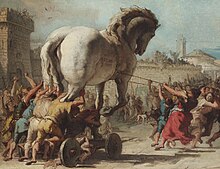
            According to legend, Achilles was himself slain shortly after the death of Hector by Hector’s brother Paris.  Now Paris didn’t have Hector's valor or courage, but he was an excellent marksman with a bow - he managed to murder Achilles by lodging a poison-tipped arrow in Achilles’ famous vulnerable heel.  The death of Achilles did not prevent the fall of Troy.  Its walls remained impregnable until a clever scheme devised by Odysseus put Greek soldiers inside.  The soldiers were hidden inside of a huge, wooden horse, which was left on a plain of the battlefield.  When the Trojans discovered the horse, they also found that the Greeks had apparently departed in their ships, leaving only one soldier behind.  This soldier explained to the Trojans that the large horse was an idol dedicated to Athena - an oracle had told them that its possessor would be the victor in this great war.  After some discussion, and against the advice of Laocoon, a Trojan priest - the one who said that famous line, "Beware of Greeks bearing gifts!" - the Trojans decided to bring the horse within their walled city.  That night, the Greek soldiers came out of the horse and opened the city gates, where their comrades, who had returned in their ships under cover of darkness, were waiting.  Troy was defeated and sacked.  All of its adult males (except a few who escaped) were killed, the women and children were taken as slaves, and the city itself was burned to the ground.

Image result for Trojan Horse


            Not all of the surviving Greeks would enjoy the fruits of victory.  Agamemnon returned home to a very bitter wife Clytemnestra, who, in collusion with her lover, murdered him in his own bathtub.  (She and her lover would in turn be murdered by her children Electra and Orestes as an act of retribution for their father's death.)  Odysseus did not see his home until after ten years of wandering at sea, during which time he lost his entire crew to various enemies and disasters.  Upon his return, he discovered that his home had been invaded by a company of suitors competing for the hand of his wife, Penelope.  He was not able to reclaim his home and kingdom until murdering all of the suitors with the help of his son, two loyal farmhands, and the goddess Athena.  King Menelaus, whose misfortunes had caused the war, returned to a more pleasant life than these men.  He’d originally resolved to murder his wife, Helen, after coming to believe that she had willingly joined company with Paris.  But upon seeing her after the fall of Troy, his anger disappeared, they reconciled, and then they returned together as a happy couple to Menelaus' palace in Sparta.

            By the dawn of the Greek historic age, when Homer was reciting his tales of the Trojan War, and Hesiod was describing the exploits of the gods, the Greek people were no longer ruled by kings.  Instead, each city-state was generally run by a privileged group, an elite caste of aristocrats or other powerful men who dominated their fellow citizens.  Many of these elite had gained their power through success in business and trade, rather than military victories or landholding.  Their rule gradually became more inflexible and harsh, particularly toward the poor and underprivileged, and it was during this time that slavery became common in the land of Greece.  In desperation, the people put their trust in self-proclaimed saviors – generally aristocrats themselves – who promised relief in return for loyalty.  But the relief was short-lived, for whenever a champion of the people gained enough power, he soon turned into a tyrant, occasionally benevolent, but often at least as cruel as the ruling class that he had overthrown.

            As tyranny became more intolerable among the peoples of Greece, bold new experiments in lawmaking began to appear.  Nowhere was this more true than in the two city-states that were destined to become the most important in Greece, Athens and Sparta.  In Athens, two great lawgivers, Solon, and later Cleisthenes, implemented a series of bold reforms that brought an end to slavery and relief to the poor, and introduced a new form of government that would be forever associated with Athens, democracy.  In Sparta, the legendary lawgiver Lycurgus introduced an equally bold, and much more radically unique, form of government. 

The civilization of Sparta was unlike any other in Greece.  Its people had evolved into a society of warriors.  Their ancestors, after founding the city-state of Sparta, had conquered the inhabitants in the neighboring land of Messenia.  But the Messenians were not content to remain a race of slaves, and the persistent threat of rebellion forced the Spartans to adopt a permanent military lifestyle.  Their children were trained to live the harsh and austere life of a soldier from a very early age, and were brought up to believe that there was no greater virtue than to be a fierce warrior, and to die in battle, if necessary.  Now this was hardly a land conducive to democracy, but the lawgiver Lycurgus did not believe that rule by an elite caste or by a single king was any better.  His solution was to create a government that was a mix of all three – monarchy, oligarchy, and democracy.  The Spartans were ruled by two kings, each from a different clan, and these in turn were advised by a council of elders.  But there was also a general assembly, which consisted of all males over thirty years of age.  Of all of the Greek city-states, only Sparta never succumbed to tyrants.  While its unique government may have helped to prevent this, the Spartan attitude toward money probably also made it difficult if not impossible for tyranny to arise.  Wealth was abhorred in Sparta, and the accumulation of it was actively discouraged through the use of large metal ingots as money.  With no wealthy class, and an underclass that was completely beaten and dominated, the conditions of social unrest that had led to tyranny elsewhere in Greece were held securely in check by the Spartans.

            In their ancient legends, the Athenians and Spartans had fought and defeated great powers in distant ages.  The Athenians could pride themselves in defeating the inhabitants of Atlantis, when the peoples of this legendary island nation had become arrogant and cruel.  And it was the Athenians, again, or rather their champion Theseus, who humbled the mighty King Minos by destroying his monstrous son, the Minotaur.  Finally, it was the Spartan king Menelaus who became the rallying point for a combined Greek army to invade Troy and reclaim Menelaus’s abducted wife, Helen, in the battle that was best remembered by the Greeks of later times.  But two hundred years after the death of the poet Homer, who immortalized the legend of the Trojan War, Athens and Sparta together would face a powerful empire that threatened to conquer, if not destroy, Greek civilization.  The empire was that of the Persians, and its leader, Darius I, turned his wrath upon the Greeks after discovering that they had attempted to aid some of the cities under his dominion in a revolt.  At first, he demanded tribute from the Greeks, and all of the city-states gave in to the demands of his agents, except Athens and Sparta, who killed the agents.  Enraged, the Persian king sent an invading army into Greece in 490 B.C., but the army was repelled by Athenian soldiers at the battle of Marathon, and news of the victory was delivered by a runner back to Athens, giving name to a race that is commemorated to this day.  Another Persian army was more successful, overcoming valiant resistance by the Spartans, but the tide of battle turned when the Persian fleet was destroyed by Athenian soldiers, and the invaders were again driven out of Greece.

Image result for battle of marathonRelated image

            Together, the Athenians and Spartans had defeated the most powerful empire of their day, but in their victory lay the seeds of their own downfall.  Athens now became a great sea power, and its great navy threatened to overshadow the legendary military might of the Spartans.  As Athens became more autocratic and inflexible, seeking to exert direct control over its Greek allies and turn them into subjects rather than partners, and as Sparta grew to envy the Athenians’ growing prosperity and influence, Sparta and its allies joined in common cause to keep this rising new power in check.  Conflict ensued, culminating in the long and mutually destructive Peloponnesian War.  The result was eventual ruin for both of these great city-states. 
           
The Death of Socrates


But it was now, during Athens’ final downfall, that she produced her greatest legacy to civilization.  For it was during this time that the greatest philosopher ever known, Socrates, enthralled young listeners with his keen mind and subtle wisdom, and left a legacy that still endures.  “All I know is that I know nothing,” he claimed, but during his life he demonstrated again and again that none was wiser than he.  If philosophy was not born in Greece, it was here that it found its fullest expression.  Even before Socrates, Greek wise men had laid the foundations for a tradition of intellectual inquiry that had never before been seen in the world.  For two hundred years, men such as Thales, Parmenides, Anaxagoras, and Democritus asked simple but profound questions that cast myth aside in the search for truth.  “What is the world made of?”  “How can we know what is real and what is true?” and “How should one live one’s life?” were the types of questions that guided their speculation.  For the first time in history, human beings – their role in the universe, their capacities, and their conduct, comprised a field of study.  “Man is the measure of all things,” a Greek philosopher once said, and this was the rallying cry for the new schools of ideas.  Today we call it humanism – the belief that man can find a purpose, a destiny, and a basis for right conduct in self-examination, and not in the supernatural.  Socrates was put to death for this attitude, but his beliefs were preserved, expanded upon, and refined through the writings of his pupil, Plato, and Plato’s equally eminent pupil, Aristotle.  Aristotle, in turn, tried to impart his wisdom onto a student of a different kind, the son of a Macedonian king.  Later, this young man, who had been the student of one of the greatest philosophers of all time, would find fame of his own, not as a sage, but as a conqueror.  Alexander the Great, as we remember him today, created an empire larger than any the world had yet seen, expanding outward from Greece to Persia and even to Egypt.  And in the wake of his conquering armies, Alexander planted the seeds of Greek philosophy which he had received from his teacher, seeds which would sprout, flourish, and survive in later civilizations, long after his own empire had fallen.

Alexander the Great

The legacy of the ancient Greeks remains with us to this day.  The simple but direct questions that they asked about truth, reality, wisdom, and right conduct, as well as many of the answers that they proposed, survive in our sciences, our laws, and even our traditions.  But there is another legacy, equally powerful, equally revolutionary, that we bear, a gift to us from another ancient people.  And just as the Greeks found their identity and their destiny through the defeat of a powerful, oppressive enemy, the Hebrews would cross the threshold of history when they successfully withstood and brought down the awesome power of the Egyptians.

Sunday, July 26, 2015

Atlantis

[The following is Episode 3 of my 16-part documentary series entitled Larger than Life, about the role that beliefs play in shaping the events of our civilization.]

            More than two thousand years ago, a visitor to Egypt from the Greek city of Athens heard a remarkable story.  The Egyptian priests told him of an ancient land, where the laws and customs of its people were so perfect that they lived in a virtual Utopia.  The place was none other than Athens, the visitor’s own homeland, as it had existed 9,000 years earlier.  But the power of these ancient Athenians was threatened by another kingdom, situated on an island continent far beyond the Straits of Gibraltar.  As one of the Egyptian priests explained:

Many great and wonderful deeds are recorded of your state in our histories.  But one of them exceeds all the rest in greatness and valor.  For these histories tell of a mighty power which unprovoked made an expedition against the whole of Europe and Asia, and to which your city put an end.

The name of that mighty power was Atlantis.


The priests described how, in the earliest times, the gods had divided the earth between them.  It had been agreed that each god would preside over the land assigned to him, or her, guiding its peoples, and establishing temples of worship.  Athens was the domain of Hephaestus, the god of fire and metalwork, and Athena, goddess of wisdom and war, and to Poseidon, god of the sea, was given the land of Atlantis.  “The island,” according to the Egyptians, “was larger than Libya and Asia put together.”  Poseidon fell in love with a mortal woman who lived on his island, Clito by name, and with her fathered five pairs of twin sons.  Upon the eldest son, Atlas, was bestowed the largest and best tract of land, and he was made king over all of his brothers.  Each of his brothers were also given a share of the island, over which they reigned as princes.  A palace was constructed for the king, which eventually became an architectural marvel:

This palace they originally built at the outset in the dwelling place of the god and their ancestors, and each monarch, as he inherited it in his turn, added beauties to its existing beauties, always doing his utmost to surpass his predecessor, until they made the residence a marvel for the size and splendor of its buildings.

For many generations, the descendents of Atlas and his brothers prospered, living harmonious and virtuous lives.  And Atlantis became a world power without rivals:

Now in this island of Atlantis, there was a great and wonderful empire which had rule over the whole island and several others, and over parts of the continent, and, furthermore, the men of Atlantis had subjected Libya within the columns of Heracles as far as Egypt, and of Europe as far as Tyrrhenia.

But as Atlantis extended its power abroad, it began to weaken internally.  Ambition, greed, and cruelty corrupted the minds of its people and kings, whose character had weakened over generations by interbreeding with the population of ordinary mortals.  Its arrogance invited divine punishment.  And Athens was the instrument of that punishment.  As the Egyptians explained to their Greek visitor:

This vast power, gathered into one, endeavored to subdue at a blow our country and yours . . . and then, (Solon,) your country shone forth, in the excellence of her virtue and strength, among all mankind.  She was pre-eminent in courage and military skill . . . . And when the rest fell off from her, being compelled to stand alone, after having undergone the extremity of danger, she defeated and triumphed over the invaders, and preserved from slavery those who were not yet subjugated, and generously liberated all the rest of us . . . . 

The divine punishment, however, was not yet complete, and even Athens was not entirely spared:

But afterward there occurred violent earthquakes and floods, and in a single day and night of misfortune all your warlike men in a body sank into the earth, and the island of Atlantis in like manner disappeared in the depths of the sea. 


            In Atlantis, we have one of the earliest visions of an empire that aspired to conquer the world.  This unbridled ambition would ultimately lead to her downfall.  Of all of the myths and legends that we have discussed so far, it seems this one has had the most enduring hold on the imagination of our civilization.  More than two thousand years after the Greek visitor’s story was recounted, the search for Atlantis continues.  In 1553 a Spaniard, Francesca Lopez de Gomara, suggested that the recently discovered continent of America was none other than Atlantis.  When the English writer Francis Bacon wrote a book describing his utopian vision of the future, he called it The New Atlantis.  In 1675, Olof Rudbeck, a Swede, argued that his homeland was the site of the ancient kingdom.  And in 1881, an American, Ignatius Donnelly, created a revival of interest in the lost continent when he argued for its existence based on facts and observations from geology, botany, anthropology, and linguistics in a book entitled Atlantis: The Antedeluvian World.  Ironically, when the story of Atlantis was put to paper more than two thousand years ago, many thought it was nothing more than a tall tale even back then.  Why, then, does the story attract so many believers in our own day?  Why do we wish to believe that a civilization as great as or greater than our own existed in some distant age?  Is it because we want to believe that there was something noble and magnificent in our past that we lost, and must now regain?  If so, then we are not really so different than the Sumerians and Egyptians, who in their own legends believed that there was a time when they were closer to their gods, walked with them, talked with them, and perhaps even shared in their powers.  Atlantis beckons us, invites us to rediscover and reclaim some earlier glory.

            But is it possible that there could have been some great civilization, older than Egypt, older than Sumer, which rose to great heights, only to eventually fall and cease to exist?  If so, did it leave to posterity dim legends of its existence, or something even more?  If the Egyptian priests were right, then that civilization met its end 11,000 years ago – long before recorded history as we know it.  Egypt’s great, ancient libraries are gone, and we are forced to conduct our search by examining myths and legends, and then seeing if there is any physical evidence that would help us to find if there is any kernel of truth to them.


            In our search, it is the ancient Greeks, again, who provide us with the most promising clues.  There is an island in the Mediterranean Sea, less than 200 miles away from Athens, called Crete, that looms large in the legends of the Greeks.  According to their mythology, Crete was once home to a great civilization, and one of its most powerful rulers was King Minos, a direct descendent of the god Zeus.  Minos angered the gods when he refused to sacrifice a magnificent white bull that had been provided to him by the God Poseidon, and as punishment, Poseidon cast a spell on his queen, causing her to fall in love with the bull and conceive a child with it, the monstrous Minotaur.  This creature, with the head of a bull and body of a man, was imprisoned by the king in a maze.  But the king had suffered from an even greater tragedy.  His natural son, Androgeus, had been murdered in Athens by agents of the Athenian king because it had been feared that the youth might stir up insurrection against him.  Pitting one tragedy against another, King Minos used the Minotaur to exact a cruel vengeance against the Athenians.  With the help of the God Zeus, who pitied him for the loss of his son, Minos compelled the Athenians to send seven young men and seven young women to him every nine years, and these were cast into his maze, left as human sacrifices for the Minotaur to devour. The Athenian people continued to suffer this wretched fate, hoping that a deliverer might someday rise up to save them from their bondage.

Now it was the turn of Aegeus, the king of Athens, to seek help from the gods.  Although he had had two wives, Aegeus had no children, and it was for this that he prayed.  He was given a magic wineskin, and warned not to drink from it until he returned to his home in Athens, or else he would die one day in grief.  But on the way back, he visited a friend in the land of Troezen, and the two could not resist livening up the evening with a little of the special wine.  Aegeus’s host had a virgin daughter, Aethra, and her father, now intoxicated by the magic wine, urged Aegeus – who was also under the influence of the potion – to visit her in her bed.  But that night the daughter had two visitors, Aegeus, and Poseidon.  The next morning, Aethra was warned by King Aegeus that if she gave birth to a son, she should tell no one that he was the father.  Aegeus’s motives were actually noble ones – he was afraid that if his enemies knew that he had a son, then the boy would die at their hands.

A son was born to Aethra - she named him Theseus, and obeyed the Athenian king’s wishes, keeping his identity a secret.  When the boy reached a suitable age, his mother took him to a large stone, and challenged him to lift it.  The boy lifted the stone, and from underneath it pulled out a sword – the sword that had been deliberately placed there by the King of Athens.  Theseus, of course, was not really the king’s son, he was in fact the son of the god, Poseidon.  But while King Aegeus’s intemperance with the magic wine might have cost him a future son, he did now have a champion to defend his Athenians.  Theseus joined the next band of unhappy youths who were being sent as tribute to King Minos.  Upon seeing him arrive, Ariadne, the daughter of King Minos, fell in love with Theseus instantly, and helped him contrive a plot to kill the Minotaur.  Ariadne gave him a special sword, along with thread to find his way out of the maze, and Theseus defeated the monster and led his fellow Athenian captives out of the labyrinth to freedom.  Theseus and Ariadne left the island together, but as with so many of these ancient tales of superhuman heroes, this one does not have a happy ending.  Theseus abandoned Ariadne before he returned home, and as he approached Athens, he committed a very fatal blunder.  He had promised the king that he would hoist a white sail on his ship, rather than the black sail that was traditionally raised in mourning for the slaughtered youths.  The white sail would assure the king that Theseus had succeeded in his mission, and had returned safely.  But Theseus forgot to change the sails on his ship, and when the King saw that the approaching ship still had black sails, and believed that his son had been killed, he threw himself into the sea in a fit of suicidal despair.
Image result for theseus ship
            This is just one of the many fabulous tales that revolve around King Minos, his family, his kingdom, and his adversaries.  We are told, for example, that his daughter Ariadne went on to marry Dionysus, another half god, half mortal, and bore him many children.  We learn that King Minos eventually became one of the judges of the dead in the underworld.  And there are the stories of Daedelus, the king’s craftsman who constructed the labyrinth that imprisoned the Minotaur.  Daedelus went on to master the art of flying with the aid of artificial wings, but then watched in horror as his son, Icarus, plunged to his death after flying too close to the sun, because the heat of the sun’s rays had melted the wax that held the artificial wings together.  In the land of King Minos, then, we find gods, sons of gods, monsters, great feats of architecture and invention, and hero’s quests worthy of a Gilgamesh.

            But is it possible that these legends have any basis in fact?  Was there ever a great kingdom on the island of Crete, so powerful that its neighbors submitted to even its most frightening demands?  Once again, we have to turn to the records of stone, buried in the earth, and whatever testimony they might provide.  And when we do, we find that there is evidence of a great civilization that existed on this island, many thousands of years ago.

            Archaeologists have named it the Minoan civilization, after King Minos of the Greek legends.  They tell us that, like Egypt, there seems to have been three great ages, or kingdoms, in Minoan civilization, which they call the old, the middle and the new.  The evidence suggests that the earliest civilization came into being on Crete about five thousand years ago, or around the same time that Menes united Egypt into a single kingdom.  In fact, there is even evidence that sometime during the period of this earliest civilization, the people of Crete had come into contact with Egyptians.  But it is during the middle kingdom, which lasted from about 2000 B.C. to 1600 B.C., that the Minoans seemed to have become a truly great people.  During this time, the city of Knossos, the legendary homeland of King Minos, became capital, and a magnificent palace was constructed there, with labyrinth-like passages and chambers, that live up to the legend of its king.  The palace was a true architectural marvel, with systems of plumbing and ventilation that were not equaled by any other country until centuries later.  The cities of that time were well planned, and it was not uncommon to find two-story buildings lining their streets.


            In this “Golden Age” of Crete, the arts flourished, as evidenced by the metal works, pottery, and wall paintings that survive.  Frescoes have been unearthed that show a people who lived a peaceful and comfortable life.  The citizens of this kingdom appeared to be happy and content, eating, drinking, laughing together, enjoying good music and dancing.  The aristocrats wore expensive jewelry, and ate at lavish banquets – a reflection of the unparalleled wealth that the Minoans had attained.  Men and women mixed freely together in the society – not a common thing in those days - and seemed to even take part in sports competitions together.  There are murals depicting young men and young women somersaulting over bulls, hinting at some type of athletic event or religious ritual that was popular at the time.  Pictures of bulls show up frequently in these artifacts, which suggests that the Greek legends had at least some basis in fact.  But unlike the legendary depictions of Crete as a militant, warlike kingdom, there is no evidence that the ancient peoples of Crete ever engaged in any kind of military conflicts.  Her cities were completely undefended, as if the Minoan peoples were not even afraid of invasion.  It seems that the Minoans obtained their wealth and affluence by becoming a great seafaring and trading people, exchanging their wares and produce with other nations bordering the Mediterranean Sea, and maybe even beyond.  The source of Crete’s great power came from merchants, not soldiers.

            But just as Minoan civilization was reaching its peak, around 1750 B.C., disaster struck, in the form of a violent earthquake.  Nevertheless, the resourceful people immediately set about rebuilding their kingdom, making its palaces and buildings even more magnificent than the ones that had been damaged or destroyed.  When another destructive earthquake shook the island in 1570 B.C., the people again set about rebuilding what had been struck down.  As it moved into its third and final age, the land of Minos continued to be a great power, rivaling that of Egypt, with dominion over islands and colonies throughout the region of the Mediterranean.  But then, some time around 1450 B.C., Crete was once again overcome by disaster, and by 1400 B.C. the kingdom was completely destroyed.  Was it another earthquake that brought the Minoan civilization to its final end, or invasion from abroad?  We may never know for sure.

            And was the land of Minos the basis for the legends of Atlantis?  After all, we have here an island kingdom, so powerful that it kept the rival land of Athens subdued, until heroes rose up from that place to break the hold that the mighty empire had over it, just as the Egyptian storyteller said the Athenians did to Atlantis.  Its first king, according to legend, had a god for a father and a mortal mother, just as the first monarch of Atlantis did.  And the kingdom met its final end after a series of natural disasters – in this case devastating earthquakes that reduced it to rubble, leaving it vulnerable to conquest from foreign invaders – perhaps even the Athenians themselves.  Even the bull, which plays such a prominent place in the legends associated with Crete, and in the pictures that were painted on its walls, has always been the symbolic animal of the god Poseidon, who in the story of Atlantis was the presiding god of that kingdom, and even the ancestor of its royal family.  The parallels are intriguing, but there are some significant differences between the story of Atlantis and the story of the land of Minos.  First, Atlantis supposedly perished some time between 9,000 and 10,000 B.C., while the Minoan civilization met its final end in 1400 B.C., some 8,000 years later.  And although the civilization of Minos collapsed after a series of natural disasters, the island of Crete never actually sank into the sea, as the land of Atlantis supposedly did.  A volcano on the island of Thera, which was located about 75 miles north of Crete, did erupt in 1600 B.C., with an explosion so violent that it caused the whole center of the island to sink, and tidal waves from the explosion might have flooded the land of the Minoans, but this can’t account for the fall of their civilization nearly two hundred years later.  Finally, according to the Greek legends, it was Zeus, not Poseidon, who was the divine ancestor of the first earthly king on the island of Crete.  In fact, Poseidon was the perennial adversary of the Minoans: the Minotaur, remember, came into being because of Poseidon’s anger at the king.  So while it is tempting to think that the mystery of Atlantis can be solved by assuming that the Greek storytellers stretched some facts and dates about events in the kingdom of their rivals, the Minoans, we cannot be completely sure that this solution is the correct one.

            Still, the story of Crete and its semi-mythical kingdom is a fascinating one, and can’t be lightly tossed aside.  The artifacts, legends, and writings that we have been able to translate hint at a great civilization that, like Atlantis, left an enduring legacy even after it vanished from the earth.  Let’s take a closer look at what has survived from the age of Minos.

            We have already talked about the prominent place that the bull seems to have held for the Minoan people.  From the Greeks we have the legend of the Minotaur, half-man, half-bull, and in another famous legend we are told that Zeus appeared to a human female on the island in the form of a great white bull, and as a result of this meeting the first of the great Minoan kings was born.  Then there is the tale of Ariadne, the daughter of Minos, who, after being abandoned by the hero Theseus, married Dionysus, another son of a divine father.  Dionysus is often represented as having the horns of a bull.  Like the first king of Crete, his father was Zeus, his mother, a mortal.  He was later revered as the god of wine and agriculture, and stories were told of how he was killed by Hera, the jealous wife of Zeus, who had him torn to pieces and devoured by gods in her service.  But, just as the Egyptian god Osiris was restored to life by other gods when the parts of his dismembered body were gathered up, Dionysus was also reborn, after Zeus retrieved his heart and planted it into the womb of a mortal woman.  Cults arose that were dedicated to the worship of Dionysus, celebrating the mystery of his death and rebirth, whose practitioners also indulged in a form of religious ecstasy, often with the help of wine or other intoxicating drinks.  In some accounts of the death of Dionysus, he was in the shape of a bull when the other gods dismembered him, and the people of Crete may have actually killed bulls during religious festivals in his honor to commemorate the event.  If so, this is another interesting link to Atlantis, whose kings, according to legend, sacrificed a wild bull every five or six years.  Centuries after the Minoan civilization had passed from existence, cults dedicated to Dionysus still existed.  During their festivals, which they practiced at night, his followers entered a religious frenzy as they danced by firelight, and believed themselves to possess occult powers as they were possessed by their god and actually felt that the god had entered their bodies.  The Greek word “entheos”, which means, “having the god within” is where our own word “enthusiasm” comes from.  The Dionysians’ secret ceremony reached a climax with the killing of an animal.  The worshipers, by eating the flesh and drinking the blood of the victim, believed that they were partaking of the body and blood of their god.  Again, this practice hearkens back to the rituals of the kings of Atlantis, who, we are told, mixed some of the blood of their sacrificed bull with wine, and poured it into golden cups.  After each king drank from his cup, and made an oath to enforce the laws of the kingdom, he dedicated the cup in the holy sanctuary of Poseidon.


Of all of the gods that we have encountered, in Sumer, in Egypt, in Greece, and in Crete, Dionysus may very well be the strangest of them all.  In many ways, he represents virility, with the horns of the bull and the wild frenzy that he could incite among his devotees.  But in human form, he is usually portrayed as young, beautiful, even effeminate.  His power is great and awesome, but it is not the power of a warrior, or a conqueror, or even a rebel.  It is the limitless, mysterious power of nature herself.  It is the chaos of life confronting death in a regular cycle of decline and rebirth, of unbounded spirit, of an ecstasy that both liberates and ravages, like the ecstasy of a drunkard, a genius, or a madman.  Is it any surprise, then, that Dionysus was also the patron god of music, poetry, and drama?  But it is also interesting to note that his earliest followers were all women.  To some, Dionysus was a terrifying figure, to others, a key to the union of the mortal with the divine.


And there is another image that appears frequently in the art of the Minoans, that of the goddess.  She is shown in the company of animals, or of young men, or as a Divine Mother holding an infant.  In fact, male gods are rarely seen; it is the feminine aspect of divinity that is most common.  The religion of Crete, more than of any other society that we have so far encountered, was a nature religion, embracing and revering the mysteries of death and rejuvenation, and of intimate spiritual communion with the divine.  The Tree of Life is another symbol that appears in the art of its people.  Even if this reverence for the feminine power of life and creation did not originate in Crete, it appears that its civilization was one of the earliest to have practiced it.  And, through their wide commercial contacts with the rest of the world as a great seafaring people, the Minoans may have been primarily responsible for spreading this religion to distant peoples and cultures, perhaps as far away as Britain.  In Sumer, in Egypt, and in Greece, there are legends of ambitious gods overthrowing older gods – or goddesses – that had ruled for an eternity before them.  The new gods were masculine in character – ambitious, combative, egotistical, and not content with the established order of the universe.  Their human followers emulated their character – conquering, pillaging, and overrunning the lands of their more peaceful, agrarian neighbors.  But the old ways survived, as cults and mystery religions, practiced in secret by devotees who sought to commune with a greater power and, through direct participation in rites and ceremonies that brought them into direct contact with the forces of nature – of death, resurrection, ecstasy, and inspiration – could find personal revelation, transformation, and liberation from the societies and other hostile realities that oppressed them.

One of the ideas that makes the legend of Atlantis so endearing to many, even today, is that there was once a great civilization, more advanced or enlightened in some ways than our own, that, while disappearing from existence, somehow managed to leave a great legacy behind.  We would like to believe that some of the citizens of Atlantis survived, and carried with them, to distant lands, remnants of their wonderful civilization, perhaps in the form of subtle truths or revelations, and that these are hidden in the ancient records of the societies where they took refuge.  The search for Atlantis continues, and may never end.  Perhaps, even if it had existed, it had already vanished thousands of years before King Minos reigned.  But in Crete, we find the nearest tangible expression of the legend of Atlantis, the record of a powerful and enlightened people who met an untimely end, but who left traces of a golden age in the many lands with which they had come in contact.  The Minoan sages, priestesses, and heroes survived the destruction of Crete, and in many ways they may still be with us to this day.

            If the great battle between Athens and Atlantis really did take place, as the ancient Egyptian historian claimed that it did, then the war and its catastrophic aftermath was of a scale unrivalled until the modern age.  But for the ancient Greeks, another great war loomed even larger in their past.  It was a war in which gods fought alongside mortals, and where the existence of an entire kingdom lay in the balance.  The war was fought in another distant land, where its people, like those of Atlantis, would fall to the Greeks and see their kingdom completely destroyed.  That land was Troy.