Monday, April 24, 2023

Critical Mass


Writing as a guest columnist for the Economist magazine a few months ago, musician and artist Brian Eno declared:


Right now we are living through the emergence of a movement of unprecedented scale and scope – the biggest movement in human history, facing up to the biggest challenge in human history.  Let’s call it the “climate-change movement”, but then let’s acknowledge that it is not just about climate change but impinges on every hot topic of the moment: the rethinking of democracy, electoral systems, economics, migration, inequality, agriculture, women’s rights, resource extraction, common ownership and personal lifestyle.


You may wonder why this planet-wide conversation about the future is not bigger news. The problem is that it is good news, which, as everybody knows, does not sell newspapers or drive clicks. Only the spectacular parts of the climate news (floods and fires) are dramatic enough to make it onto television, so we get to see only the bad news. Underneath the news, though, slow and deep, is a movement of long horizons and structural rethinking, not attracting much attention until it gets angry. But a rich and robust root system is growing, and its first green shoots are starting to break the surface.


Brian Eno

While I have the highest regard for Brian Eno, and respect his artistic genius as well as his ideals, I must sadly say that I’ve heard all of this talk before about an emergent movement on the cusp of changing the world.  As I noted in an earlier entry: “Okay Boomer” (https://johnsemeraldtablet.blogspot.com/2020/05/okay-boomer.html), a similar ideal was expressed in Marilyn Ferguson’s 1980 book The Aquarian Conspiracy.  In its opening chapter she writes:


A leaderless but powerful network is working to bring about radical change in the United States.  Its members have broken with certain key elements of Western thought, and they may have even broken continuity with history.


This network is the Aquarian Conspiracy.  It is a conspiracy without a political doctrine.  Without a manifesto.  With conspirators who seek power only to disperse it, and whose strategies are pragmatic, even scientific, but whose perspective sounds so mystical that they hesitate to discuss it.  Activists asking different kinds of questions, challenging the establishment from within.


Broader than reform, deeper than revolution, this benign conspiracy for a new human agenda has triggered the most rapid cultural realignment in history.  The great shuddering, irrevocable shift overtaking us is not a new political, religious, or philosophical system.  It is a new mind – the ascendance of a startling worldview that gathers into its framework breakthrough science and insights from earliest recorded thought.


As I noted then, the 1970s and 1980s were characterized by a number of such ideas, which shared the common belief that through the collective enlightenment of a growing number of individuals, a critical mass would emerge that would change the world in a number of profoundly positive ways.  There were a number of such “Aquarian” movements around that time that stressed personal growth and enlightenment as a vehicle for general social reform, but none of these led to the fundamental social transformation that was hoped for or promised, in spite of the fact that half a century has passed since the decade that spawned them. 


And, as I survey events in the world and in my own country, I find little evidence that such a widescale positive, enduring change is imminent.  In China, the most populous nation in the world, the citizens are living under a condition of extreme political repression, and its leadership is carrying out an international agenda that is strictly pragmatic and devoid of any underlying basis of moral values.  And in the United States, a prosperous nation (it ranks 8th among all nations in terms of GDP per capita), where citizens enjoy a large measure of personal liberties, one of the two major political parties has all but denied that climate change is a serious problem, and has offered little support for any significant measures to address it, and has often resisted them outright.  One would expect that at least in countries where citizens are relatively prosperous and/or free, there would be tangible evidence of a large and growing number of enlightened persons actively engaged in improving the world.  Perhaps Brian Eno is right when he says that they are there, but are simply being ignored by the news media.  But although I count many if not most of my friends as having liberal sentiments, I see little evidence of the concerted activism among them that would lead to significant positive change on a large scale.  I don’t even harbor much hope that there will be a large enough majority of them to enact enduring solutions through the political process – at least in the foreseeable future.


And just what kind of enlightenment would convert a person into a functional world-saver?  Clearly, just becoming more fully aware – and critical – of the world’s injustices and environmental problems is not enough.  There is no shortage of “armchair liberals” (of which, admittedly, I must include myself).  There of course have been many instances in history where bringing a problem into the public consciousness in a stark or compelling way has galvanized the masses to demand reforms, as Harriet Beecher Stowe’s Uncle Tom’s Cabin did with slavery, Upton Sinclair’s The Jungle did with unsanitary practices in the meat-packing industry, and Rachel Carson’s Silent Spring did with environmental issues.  And while raising the awareness of a critical issue in such a way that it leads to collective action cannot be discounted as an effective catalyst for positive social change, I think that what is being envisioned by the “Aquarians” and others like them is something broader and more enduring.  It would be a sort of enlightenment that changes one’s entire perspective on life and existence, in a holistic sort of way, but more than this, it creates a fundamental and life-altering shift in one’s personality, compelling active, positive engagement with the world to a very significant degree.  It is not hard to imagine that if a sufficient number of these individuals emerged, they could reverse the downward spiral of our civilization and put it onto a healing trajectory.


But the hope and promise of positive enlightenment growing into a world-saving force has appeared many times in our history, long before the present – even long before the hope and expectation of an “Aquarian age” that infected the popular consciousness half a century ago.  Perhaps the most significant historical example of this is the rise of Christianity, whose central figure preached that the most important two commandments are to love God and to love one’s neighbor as oneself.  Early converts to this movement believed that their faith had changed them in a fundamental way: had enabled them to become “reborn” in a spiritual sense.  Admittedly, the earliest Christians entertained no ambitions about growing in numbers to a size large enough to transform their civilization, let alone the world.  Their hope was in a heavenly kingdom that was yet to come, populated by a community of saints.  But by the time the Emperor Constantine had personally converted to Christianity in the early 4th century (and that otherworldly kingdom of the early Christians, which many expected to arrive in their lifetime, had failed to appear), there must have been growing hope among Christians that as their religion continued to gain the tolerance and even support of the empire, and won an increasing number of converts, then it would eventually create an earthly version of that heavenly kingdom.  Saint Augustine, however, writing about a century after Constantine’s conversion, continued to stress the importance to Christians of that otherworldly kingdom, since Rome had been recently sacked by Visigoths, leaving the future of its empire in doubt.  Ironically, when the Gothic invaders themselves eventually converted to Christianity, this made the dream of an earthly Christian kingdom once again tenable.  And in fact, for over a millennium, until 1806, much of Europe was ruled by what was known as the “Holy Roman Empire”: a Christianized version of the empire that had fallen to the Goths and other Germanic invaders.  Sadly, however, the Christianized nations – both within and without the Holy Roman Empire – fell far short of the ideals of the earliest Christian teachings.  There were organized persecutions of pagans and heretics, and mob-induced persecutions of Jews and other non-Christians.  The Crusades were fought – at the Christian popes’ direction – against non-Christian nations.  And eventually, after the Protestant Reformation, there were extended, violent wars between the Christians themselves, allied to different sects, and Christians even found themselves persecuted by Christian monarchs, if they failed to belong to that monarch’s particular sect.  It is hard to fathom how a movement founded on the ideal of universal brotherhood and devotion to a moral, benevolent deity could – upon reaching a critical mass in civilization – have produced such horrible results.


But those who blame all of the evils of western civilization on the rise of Christianity go too far in their condemnation.  At the very least, one can ask if that civilization would have been more benign and less bloodthirsty if paganism had remained the dominant religion of Europe.  I doubt it.  I can attest, too, from personal experience, that I have known many individuals whose Christian beliefs have provided a solid moral compass in their lives.  I am sure that this has been the case for many persons who have lived by that faith.  As Brian Eno has said about his own movement, the rank-and-file benevolent Christians are not “spectacular” and therefore not newsworthy.  It is those in power who make the news, and throughout history power has corrupted many a leader, warrior, or even preacher who has called himself a Christian.


And of course it goes without saying that the evil done in the name of Christianity, or even just by Christians themselves, runs contrary to the teachings of Jesus and the writings of St. Paul.  And this is not just true of Christianity.  Something just seems to happen when a spiritual idea or discipline gets formalized into a religion – particularly one that gains power in numbers.  Even Buddhism, a doctrine that is probably most associated in the general public’s mind with the very word, “enlightenment”, contains dark episodes in its history, as in imperial Japan in the 1930s, when many Buddhist leaders supported and collaborated with the militaristic regime.  Ichikawa Hakugen, an eminent Japanese Zen Buddhist scholar who lived at that time, reinterpreted many fundamental tenets of Buddhism in a way that justified such collaboration.  But much earlier, in 9th-century China, Buddhists themselves had been the targets of widescale persecution, culminating in the destruction of thousands of monasteries and tens of thousands of Buddhist temples.  Their persecutors, ironically, were practitioners of Daoism – a philosophy famous for eschewing formal doctrines of any kind – because they had grown jealous of the growing popularity of Buddhism in China.


This, then, seems to be an almost an inevitable outcome of mass enlightenment:  A system of beliefs inspired by spiritual insights – usually originating from a wise, illuminated teacher – gains a growing number of adherents, and with the growth of the movement and the passage of time, there is a perceived need to formalize the system with a codified set of laws and practices, and a clear division between clergy and laity – between leaders and followers, but the organization that emerges becomes politicized, both internally and externally, inviting all of the inherent risks of corruption, abuse of power, and outright hostility toward “non-believers”.
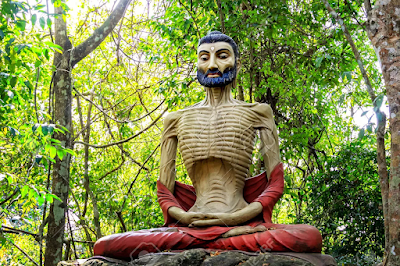


A different – almost opposite – pitfall of enlightenment is the sort associated with Buddhists, Hindu yogis, Muslim Sufism, and Christian mysticism, in which the attainment of enlightenment becomes a sort of end in itself, and the “awakened” practitioner becomes divorced from the world of ordinary day-to-day activities, often as a recluse or a member of a monastic community.  The purity of their lifestyles, as admirable as it might be in itself, provides little tangible service in improving the world, beyond extending their enlightenment to new converts and acolytes.


But has there ever been an activist enlightenment, in which an “awakened individual” actually becomes more engaged with the surrounding world, in an attempt to reform it, improve it, even save it?  Sri Aurobindo, a pro-independence activist in early 20th-Century India, provides an interesting biographical example.  After being imprisoned for a year in solitary confinement for suspected revolutionary activities, Aurobindo turned from politics to spirituality, receiving instruction from a Maharashtrian yogi.  Over the next two decades, he developed a spiritual system called “Integral Yoga”, which at its core has his assertion that the physical world is not an illusion, as so many mystics contend, but is real, and in its reality is subject to evolution and transformation.  The traditional attainment of higher consciousness, Aurobindo argued, is merely an intermediate step, which can be followed by a descent back into the world of day-to-day existence.  He termed higher consciousness “Supermind”, which, once attained, can enable one to play an active role in evolving the entire world and its creatures to a greater level of spiritual advancement.  In his words:


Supermind is a plane of perfect knowledge, that has the full, integral truth of anything. It is a plane that man can rise to, above his current limited mentality, and have perfect understanding through revelations and power that is leaning down on the earth's consciousness. One can open to it, in order to transform the various aspects of one's being, as well as set right the conditions of life, . . .


According to Aurobindo, one who has attained the Supermind, or supramental consciousness, becomes, in his words, a “Gnostic being”, and he believed that when a sufficient number of these Gnostic beings appeared – reaching a critical mass – then a new world order would result.  Aurobindo contended that his Integral Yoga was actually based on ancient traditional Indian holy writings, such as the Upanishads.  And yet, he apparently believed that very few if any human beings had ever moved beyond the traditional, passive mode of mystical illumination to the next, activist stage which would catalyze the spiritual evolution of the physical world.  His anticipation, or hope, was that through the practice of integral yoga, the widespread appearance of such individuals would finally occur.  While his spiritual system attracted many followers in the 20th Century, it seems to have run its course, falling fall short of a number capable of catalyzing global spiritual evolution.


Occultism, in many of its branches and guises, has also been touted as providing a path of higher learning and even transformation to its adherents.  Much of the popularity of occult disciplines – such as astrology, alchemy, Hermeticism, and Tarot – can be attributed to the common belief that they are ancient in origin: either relics from some scientifically and spiritually advanced antediluvian civilization, or wisdom passed down, through the ages, by an unbroken chain of Masters, perhaps since the dawn of humanity.  The belief is generally unfounded, with most of these disciplines, at least in their current form, having been introduced within the past two thousand years.  In many cases, modern occultists have even fraudulently credited works of their own creation to earlier sources, in order to give them a greater air of authenticity.  But Carl Jung, and many psychologists and mythologists inspired by his writings, have conferred a greater legitimacy on various forms of occultism by suggesting that they provide universal symbols that have survived in the collective unconscious of humanity, and periodically find expression in art, mysticism, and religion, not to mention intense personal psychological experiences.  Well-intentioned, scholarly occultists have attempted to distill the deeper symbolic meanings of the various occult disciplines.  Some of these occultists, like Paul Foster Case, went even further, by endeavoring to integrate the fundamental insights of astrology, alchemy, Hermeticism, Tarot, and even the Jewish mystical tradition of Kabbalah into a unified wisdom teaching.  In 1933, Case founded a school of thought called the “Builders of the Adytum” which was dedicated to the passing on of “Ageless Wisdom” to those who wished to seek it and thereby to ultimately find the “Way of Liberation”.  As with Sri Aurobindo, Case and others who had similar perspectives about the ultimate wisdom of occultism believed that by attaining this wisdom, human beings would not only elevate themselves to a higher spiritual and intellectual plane, but would then become agents for the elevation of humankind in general.  But, as with Aurobindo’s followers, those associated with the “Builders of the Adytum” and similar occultic movements seem to have fallen short of reaching any level of influence.


It is of interest to note, however, that there have been occultic fraternities, such as the Freemasons, which seemed to have lived up to the promise of enlightened individuals within their fold enacting positive social change.  The rolls of famous Freemasons include Ben Franklin, George Washington, Winston Churchill, Franklin D. Roosevelt, Voltaire, and Sir Alexander Fleming, and another occult fraternity, the Rosicrucians, counted as their members Abraham Lincoln, Isaac Newton, Leonardo Da Vinci, and Francis Bacon.  But it is an open question whether the actions of these individuals were actually shaped and motivated by their involvement in these organizations, or the fraternities simply attracted persons of character and merit at the time that they lived.  Both the Freemasons and the Rosicrucians have certainly had members whose contributions to society are mixed, at best, such as the Freemason J. Edgar Hoover, and the Rosicrucian Napoleon Bonaparte.


Of course, there is and always have been many popular books providing guidance on personal enlightenment, particularly during the past century, including A Course in Miracles, published in 1976, and the works of Eckhart Tolle, such as The Power of Now, published in 1997.  Dr. Joseph Michael Levry, in his book Lifting the Veil: The Divine Code, originally published in 1994, combined the teachings of Jewish mystical Kabbalah with a brand of yoga (“Shakti Naam”) which, he promised “will take away your fears, and empower you to reach your goals at the same time helping others to reach theirs.  These teachings will expand your consciousness, purify your mind, and illuminate your life.”  But more than this, he asserts that:


This book is for Yogis, Kabbalists, doctors, serious health practitioners and everyone who desires to walk the distance from the head to the heart, so as to contribute to a positive evolution of the human race.


Even the Jewish Kabbalah itself, an ancient form of mysticism which had been the subject of serious study among scholars such as Aryeh Kaplan in the 20th century, was popularized by Philip Berg and the Kabbalah Centre later in that century to give it a broader appeal, eventually gaining popular celebrities as adherents, with promised benefits going beyond simple spiritual illumination to more practical things like personal success, good health, and the finding of an attractive mate.  And conventional motivational speakers, who had traditionally provided guidance on attaining these more practical things, have increasingly moved from the opposite direction, expanding their list of promised benefits to a heightened spirituality. 


An intriguing variant of the enlightened activist has found expression in a series of books authored by Bill Plotkin, most recently in his The Journey of Soul Initiation: A Field Guide for Visionaries, Evolutionaries, and Revolutionaries (2021).  Plotkin believes that with proper guidance, any person can proceed through a series of stages that will ultimately result in his or her transformation to an “eco-soulcentric” being, committed to saving and improving the earth by relying on a unique, personally-tailored set of skills and insights that were obtained as a result of that process of transformation.  He sees the process as occurring in 5 distinct stages – preparation, dissolution, soul encounter, metamorphosis, and enactment – and likens it to the transformation in nature that occurs when a caterpillar enters a cocoon, undergoes a metamorphosis, and emerges as a butterfly.  This metaphor and its application to human transformation is not unique to Plotkin, of course:  As I described in a previous blog entry, “The Invisible Hand” (https://johnsemeraldtablet.blogspot.com/2019/03/recently-i-happened-to-finish-abook.html), Na’im Akbar uses the very same metaphor, and in a very similar way, in his book Natural Psychology and Human Transformation (1977).  In that entry, I drew parallels between Akbar’s model of transformation and the “hero’s journey” described by mythologist Joseph Campbell.  Interestingly, Plotkin strives to distance his own model of transformation from that of Campbell’s, contending that Campbell’s is describing a rite of passage in which, after going through an ordeal or some other unusual and overpowering experience while removed from his familiar surroundings, a man (it is traditionally a man in these earlier rites of passage) returns to his own people with the necessary insights and capabilities to be a more functional member of his community.  But I think that this distinction is forced, and misses the point of Campbell’s fundamental insights.  Campbell (along with Akbar) is also describing a personal transformation that can only occur when one is thrown into a sort of chaotic trauma and is forced to tap into a reality that is not grounded in the conventional cause-and-effect, timebound, perceptible realm, but instead lies beyond this, and contains a deeper, more profound wisdom that can be drawn upon to change oneself, and perhaps change one’s community as well.  Whether the source of this wisdom lies in the collective unconscious – a sort of genetic, primal, symbol-infused memory bank common to all human beings – as Carl Jung would contend, or instead is a transpersonal intelligence that somehow pervades the universe and can be drawn upon under certain propitious circumstances (or both), this wellhead seems to be the source that enables those who tap into it to produce great inventions or inspired works, or acquire world-changing personal destinies, or at the very least to become a more fully functional, wiser human being.  


(Source: The Animas Institute)

Plotkin also strives to make a distinction between the transformational processes that initiates of his system undergo and the various shamanic traditions and initiation rituals that have existed in various places since the dawn of human history.  But many of those initiates who have undergone the processes described in his books have engaged in shamanic-type things like extended wanderings in the desert or wilderness, and what can only be described as mind-bending experiences brought on by unusual encounters or mental episodes (these latter sometimes fueled by hallucinogenic substances).  He concedes that similar shamanistic practices in earlier ages might have produced “eco-soulcentric” human beings, which he refers to as “Adults” or – in those who have attained the highest levels of this form of enlightenment – “Elders”, but admits that there is no evidence to confirm this.


In fact, Plotkin is among those individuals who believes that in the primitive recesses of our past, we were living in a more paradisical state, unsullied and uncorrupted, until:


. . . [W]ith the advent of agriculture and farming – the domestication of selected animal and plant species – came, inevitably, the pathogenic notion of personal property and the inexorable outcome that some people would conclude that hoarding things for themselves is a good idea. . . .


. . . The Tribe becomes increasingly materialistic, competitive, anthropocentric, and violent – and disconnected from the natural world in which everything shares freely with everything else and there is no waste. . . .


He is, of course, not the first person to entertain this idea of a Fall from Grace.  (I describe others in “Okay, Boomer”, https://johnsemeraldtablet.blogspot.com/2020/05/okay-boomer.html.)  It is a pernicious myth that has gone beyond its religious roots and infected many well-meaning secular intellectuals, as well.


I have heard it lamented that the oppressive encroachment of civilization on indigenous cultures has run roughshod over the shamanistic traditions that they often possessed, along with whatever eco-friendly wisdom that were inherent in them, to our collective detriment, and I had once held at least some sympathies with those views.  But recently I happened to watch a movie titled Fire on the Mountain: A Gathering of Shamans (filmed in 1997 and available for free viewing on the internet) which documented a “ten day retreat of tribal elders, wisdom keepers, and medicine women from five continents” and which was highlighted, at the end, by a visit from the Dalai Lama.  When I started viewing the movie, I really intended to be personally moved and impressed by these diverse, time-honored traditions that were in danger of obliteration.  But as I got into the movie, I was shocked by my overall reaction.  It was one of derision.  The ramblings and ceremonies of these various groups of shamans, and the occasional squabbles that erupted over conflicting world views between them, just looked profoundly silly to me.  I came to the sardonic conclusion that it was no wonder that these traditions have been, or will be, run over by the progress of civilization, because they are generally grounded in nonsense.  I also recently watched another documentary titled Art Meets Science and Spirituality in a Changing Economy, which covered a retreat that took place for 5 days in 1990.  This one, as the title indicates, featured artists, scientists (at least some of whom, like biologist Rupert Sheldrake, entertained theories outside of the mainstream), economists, and members of various spiritual disciplines.  This retreat, too, featured a visit by the Dalai Lama (who seems to have made it a permanent feature of his personal career to make cameo appearances like these).  And it strangely echoed the one with the shamans, with the general lamentation that our contemporary civilization, with its scientific worldviews and ways of conducting business, has estranged itself from the world (or universe) at large in a very toxic sort of way.  This lamentation was expressed very eloquently in both retreats, but what both completely lacked was the identification of any concrete, practical solutions for rectifying this problem, or an alternative comprehensive worldview from which such solutions might emerge.


The people of India, a land historically known for its deeply mystical traditions and the yogis, fakirs, and other religious sages associated with them, did not rise out of its general squalor and misery because these sages reached a critical mass of numbers or influence.  It happened when India’s political leaders embraced market-based capitalism, which is often derided by people like those who attended the retreats as one of the toxic byproducts of civilization.  Nevertheless, there are real ecological problems that we face, and that seem to be reaching the general crisis stage, if they have not already.  And while I am frustrated by those who minimize the severity of these problems by expressing their unbounded confidence that civilization and innovation – often induced or enhanced by market-based mechanisms – will solve them in due time, I have to concede that they have a history of examples to justify their optimism, when doomsayers in the past, asserting that overpopulation, pollution, or large-scale extraction of vital resources would lead to global calamities by such-and-such a date, have been repeatedly proven wrong.  But even scientists are now expressing concerns that we are reaching the limits of innovation, and that we might be on the cusp of facing global problems that could overwhelm us.  Perhaps we really have reached a point where only a general reorientation to the world will enable us to restore a sustainable balance between preserving both our civilization and the general ecosystem of which it is a part.  Plotkin believes so, and that his – if I may coin the term – “neo-shamanism” will produce this reorientation among the “Adults” and “Elders” who successfully undergo the transformation, but again, only if they reach a critical mass:


.  . . Once there enough true Adults and Elders in a human community, their visionary projects link up in such a way that the whole society goes through a developmental evolutionary unfolding. . . .


. . . [T]rue Adults and Elders are the imaginal cells of emerging eco-soulcentric butterfly societies.  Taking this idea a step further, we might imagine that these butterfly societies will eventually serve as the imaginal cells of the next phase of human evolution – from a caterpillar species to a butterfly species – and this might in turn result in the next major step in Earth’s evolution.   As a species, we are now in a Cocoon.  What percentage of butterfly societies will be needed globally before Earth begins to transform into a butterfly planet?


I still worry, however, about that final critical step from personal enlightenment to enlightened action.  Even if these “Adults” and “Elders” have the motivation to do everything in their power to change the world, or, in Plotkin’s words, to contribute to an important major next step in Earth’s evolution, they still have to face the naked power of the gun (as Mao Zedong famously said, “Political power grows out of the barrel of a gun”), and those unenlightened leaders or militants who have no reservations about using blatant force, not to mention subtler but equally effective powers of aggression and suppression.  And for this reason, and the others I outlined above, I continue to be skeptical about “critical masses”, in whatever form they take, from the early Christians, to the New Agers of the 1970s and 1980s, to the contemporary followers of those who are holding out the hope of a path to global reform by promoting their own various programs of personal enlightenment. 


Perhaps, in our present time, a modern-day Buddha, or Jesus, or even Mohammed might usher in a new phase of higher spirituality that will appeal to the masses and rock the foundations of civilization, in a good way.  On the other hand, if a global crisis appears of sufficient severity, perhaps one or more capable and principled secular leaders will bring out the best in us: inspiring and motivating us to address and resolve the crisis in a substantial and enduring manner.  But each of these hopeful alternatives, while not entirely implausible, also seem highly unlikely to me, and for this reason, I remain skeptical . . . and pessimistic, and am certainly not pinning my hopes on the emergence of a “critical mass” of wise and committed human beings to change the world.  But my pessimism is not unbounded.  While it is dangerously complacent to adopt the view that there will always be saviors and/or innovators who keep us from moving beyond the brink of destruction, it cannot be ignored that many in history who have tapped into that deep, mysterious well of sub/super-conscious wisdom have invented or accomplished some remarkable, often world-changing things.  So maybe it is not a critical mass that is required, but simply the guidance and contributions of individuals who have taken a sufficiently deep dive into that well, and who can then usher us into a higher phase of civilization, or perhaps of evolution itself. 

Tuesday, November 29, 2022

The One


I recently had the opportunity to post a birthday greeting on a message board for Jimmy Carter, who, at the time of this writing, is 96 years old.  I will always hold a special regard for Jimmy Carter, as he was the first U.S. President that I ever voted for, but more than this, his personal character and integrity did much to restore faith in an office that had been severely tarnished in the public eye after President Richard Nixon resigned in disgrace two years before Carter’s election.  That was in 1974, and for those of us Baby Boomers who had grown up in the turbulent 1960s and were approaching adulthood in the 1970s, that resignation just tangibly reinforced a general mood of cynicism about those who wielded power in this country.  We who voted for Jimmy Carter saw in him a sort of national savior who would restore our trust in government.  It saddens me to see him regarded now by many as a good man who was an ineffectual or unaccomplished president.  I think that his legacy is underappreciated.  America had been sinking into an economic malaise throughout the 1970s, culminating in both high unemployment and high inflation, but President Carter oversaw the implementation of measures that provided long-term solutions to these problems.  He embraced deregulation as a means of using market forces to reinvigorate stagnant industries, appointed Paul Volker – the man who implemented the stern economic measures necessary to combat inflation – as Chairman of the Federal Reserve, and created the Department of Energy in order to directly address the energy crisis that was also raging at that time.  The end of his term was clouded by the taking of American hostages during the Iranian Revolution,  but although their release occurred after the inauguration of his successor, Ronald Reagan, the negotiations that led to this were done by the Carter Administration.  In any case, President Carter was a hero to many of us when he was elected, and for many of us – perhaps even more now than then – he remains a hero to this day.

As I reflect on Jimmy Carter’s life and career, I realize that there have been many times in the history of civilization when somebody appears at a critical moment to solve a crisis, or repair a long-festering problem that has grown to an unbearable magnitude.  For those of us in the 1970’s, Jimmy Carter was “the One” and, in more recent years, President Barack Obama was regarded by many – literally – as “the One”.  He was elected to office in the midst of the greatest economic crisis since the Great Depression, and played a critical role in ensuring that those who were best able to address the crisis could do so.  But, like Jimmy Carter, I think that he was saddled with unrealistically high expectations by his voters, who hoped that he would not only solve the country’s economic ills, but make great strides in healing more fundamental societal problems, like the nation’s racial divide.  Nevertheless, I think that he will be remembered as one of America’s better presidents, except among those who were and are unable to look past the fact that he is black.  Other American presidents come to mind who were perceived by many as national saviors when they assumed the office.  George Washington had already secured his reputation as the successful leader of the Revolutionary War, and the chairman of the Philadelphia Convention that led to the drafting of the Constitution, but as U.S. President he proved to Americans – and to the world – that a national leader could be elected and peacefully transfer power to a duly elected successor.  He was the original “One” for the United States.  Franklin Delano Roosevelt also comes to mind, having been elected during the Great Depression, and later faced with leading the nation in another world war.  (I exclude Abraham Lincoln from this list.  In retrospect, he was of course a national savior of the highest order, but at the time of his election, he was not considered as such, even among his supporters, and in fact his election was the precipitating cause of the Civil War.)


It we look back into the farthest reaches of the history of human civilization, we find that certain persons appear at critical moments to repair, or reform, or even create new institutions that will enable civilization to continue its forward progress.  Sargon the Great, the founder of the world’s earliest recorded empire, had humble beginnings as the son of a gardener, but after usurping the power of a regional king went on to unite the entire land of Mesopotamia around 2300 B.C., and his method of governance became a model for subsequent rulers over the next 2000 years.  Even earlier, to the east, Menes created the First Dynasty of what would become a long line of pharaonic rulers by uniting Upper and Lower Egypt, around 3000 B.C.  Of course, while remembered for creating and establishing the world’s earliest extensive civilizations, these men were conquerors, but to find one of history’s earliest examples of a liberator, we need only move forward in Egypt’s history to around 1200 B.C., when Biblical tradition tells us that Moses freed the Israelite slaves from Egyptian bondage, and laid the foundation for a new kingdom, with a unique and enduring monotheistic religion.  Moving further forward, to the 6th Century B.C., we come to the great lawgivers of Classical Greece and Rome, beginning with Solon, who cancelled all of the debts that oppressed much of the people of Athens, and expanded rights of democratic participation beyond the more affluent classes of citizenry.  Although Athens succumbed to tyranny again during Solon’s lifetime, within a generation of his death another great lawgiver, Cleisthenes, oversaw the restoration of representative government and enacted further reforms, so that he is known to posterity as “the father of Athenian democracy”.  Like Moses, who had enjoyed a privileged upbringing in the royal household of Egypt, both Solon and Cleisthenes had aristocratic backgrounds, with power and prestige, but also like Moses, their sympathies had turned to the oppressed within their societies, and they had taken upon themselves a personal calling to relieve that oppression.  And before the end of that same century, in Rome, monarchy would give way to a republic, after the rape of a married woman, Lucretia, by the son of Rome’s king, would inspire a man named Brutus to lead a revolution overthrowing the despotic royal family.  (Lucretia had died from suicide after her rape, adding to the general outrage fomented by the crime perpetrated upon her.  Are we seeing an echo of Lucretia’s martyrdom in present-day Iran, where the senseless murder of a young woman there by a member of the clerical tyranny has led to a general uprising?  The outcome of that revolt is at the time of this writing uncertain.  Perhaps what is still needed there is a leader: their own Brutus – perhaps a female one.)


In the past century the world has seen outstanding examples of “the One”.  As a young man, Mohandas Gandhi had studied law at University College, London, earned a degree, and became a lawyer.  But after moving to South Africa, he soon learned that his degree, his profession, and the wearing of European-style suits would not prevent him from being treated with contempt and condescension by the whites who lived there.  While he had harbored sympathies for the oppressed and underprivileged even before his move to South Africa, these humiliating personal experiences would galvanize him into an activism that would culminate in the liberation of his Indian homeland from the British.  Decades later, in the United States, a young Martin Luther King would witness the same expressions of contempt, condescension, and discrimination that had inspired Gandhi’s activism, and he adopted Gandhi’s philosophy of non-violent resistance in the pursuit of his own quest for widespread social reform.  Both men died from an assassin’s bullet, but not before they had left an enduring legacy to the cause of social justice and equality.

But what circumstances invite the arrival of such persons?  Often it is a single galvanizing event, which highlights a growing malaise that has reached the limits of toleration.  In ancient Rome, it was the rape of Lucretia that exposed the ugly arrogance of the ruling monarchical elite, and incited Brutus to lead its overthrow.  In the mid-twentieth century, the rise of Adolf Hitler’s Nazism and its associated abuses had been going on for years, downplayed and ignored by European powers reluctant to enter into another general war, including Britain, until the invasion of Poland compelled a response.  Britain and France declared war on Germany, but of particular significance was that this, in turn, was the signal event that brought Winston Churchill back from the political “wilderness” into a pivotal role, first as Britain’s Lord of the Admiralty, but eventually as its Prime Minister and wartime leader.  Churchill had warned of the Nazi menace for years, and is now remembered in history as the hero who saved his country, and western civilization in general, from that menace ultimately prevailing.  In the United States in 1955, the abduction, torture, and lynching of a teenaged black boy, Emmett Till, by white racists, and the subsequent acquittal of his murderers by an all-white jury, raised national awareness of the egregious abuses perpetrated against blacks, particularly in the American South, and paved the way for a re-energized civil rights movement that would eventually have Martin Luther King as one of its most vocal and transformative leaders.


Churchill and Roosevelt

Often, it is not an outrage but a general breakdown in some fundamental institution that proves to be the galvanizing event calling for a transformative leader or hero.  Such was the case with the Great Depression of 1939 and Great Recession of 2007, which contributed to the elections of Franklin Delano Roosevelt and Barack Obama, respectively, to the American presidency.  The Watergate scandal and President Nixon’s resignation similarly contributed to the successful election of President Jimmy Carter.  The rise of the great lawgiver Solon in ancient Greece occurred when he was granted special powers by his fellow Athenians in order to reform a dysfunctional government that had regularly succumbed to the competing ambitions of tyrants.  Sometimes a revolution that has already begun finds itself in search of a leader, and if a person of suitable talent and integrity answers that call, as George Washington did in the American Revolution, its chances of success greatly improve.  But at other times no such person emerges – or at least no such person of sufficient talent, vision, and integrity – and the revolution falters, and ultimately fails.  In recent history, this seems to have been the case with the “Arab Spring” uprisings in the 2010s, and the upheavals in Iran in 2017-2018.  There are of course worse outcomes for revolutions that fail to find a leader, and that is when a successful leader emerges who ultimately proves to be one lacking in character.

Such leaders put themselves forward, of course, as saviors and liberators, but, once in power, they become despots and conquerors.  The promises that they offer – to restore order, or prosperity, or former glory – represent a Faustian bargain in which more is lost than is gained, and in fact sometimes leads to general devastation.  This happened during the final decades of republican Rome, in the 1st Century B.C., when a growing divide between rich and poor created civil disorder, exacerbated by a Senate which pursued interests increasingly divergent from the general populace.  Two competing military leaders – first Marius, and then Sulla – took control of the capital city, and exacted punishing measures against the allies of the other, including executions and the taking of their property.  By the time that Julius Caesar had risen to power, in the middle of that century, with a promise to restore order, the Roman republic was dead, with the Senate a merely token vestige of representative government.  And while Julius Caesar died at the hands of a rebel Roman politician (another Brutus, although unlike his namesake, an unsuccessful revolutionary), the Roman imperial government was eventually secured and permanently established under the rule of his successor, Augustus Caesar.  A drama not unlike this was repeated in the chaotic years of the French Revolution, when the mass executions which occurred during what came to be known as the Terror were followed by the rise of Napoleon Bonaparte.  And while he initially brought glory, power, and prestige to a renewed France, and fostered innovations in both science and jurisprudence, his personal thirst for power and general domination in Europe produced a succession of wars, ending in the humiliation of France, the decimation of its armies, and the exile of Napoleon himself.


Caesar and Bonaparte are two conspicuous examples of the dark side of “the One”.  Each promised to restore order to a people that had been thrown into a violent, destructive chaos by long-festering economic distresses and the failure of government to address them.  The promise of order, security, and safety under such circumstances is a particularly effective means for men such as these to rise to power.  Others of their kind have resorted to similar promises, generally involving the restoration of a former greatness to their people.  Initially, such leaders seem to make good on these promises, until their actions lead to a final, devastating end.  When Germany, in the wake of its defeat in World War I and the global economic depression that followed a decade later, was left humiliated, militarily weak, and bankrupt, Adolf Hitler promised to restore a former glory that would last for a millennium.  But like Napoleon, his ambition to conquer his European neighbors, including Russia, ultimately led to defeat and devastation.  And here, perhaps, is a clue to spotting the poison in the promises of leaders such as these, who offer a way to bring back a lost grandeur, because the means that they pursue often run directly counter to what genuinely made their people great.  Throughout the 18th and 19th centuries, Germany was renowned for producing some of the greatest musicians, mathematicians, scientists, and philosophers that the world had ever seen, but Hitler did not see its greatness there.  Instead, he found it in darker places, including Germany’s historical tendency to militarism, and its bigotry and prejudices, most notably antisemitism.  One could argue that Chairman Mao, and now Chairman Xi, pursued and are pursuing the same course with the Han Chinese, who have contributed to the world a rich and time-honored tradition of philosophical and spiritual thought in the East, and who have also been renowned for their entrepreneurial acumen.  (My roommate in college, who was Vietnamese, used to tell me stories of his childhood back there, and how if one or two Han Chinese families moved into a village, they would eventually own all of the shops and stores in that village.  It was a back-handed complement, to be sure, but a sincere one.)  The stifling, state-controlled economies of Mao and Xi have all but destroyed freedom of thought and discourse, and have dampened the entrepreneurial spirit that had once thrived in places like Hong Kong, and still does in Taiwan today.  In their avowed aims to make China and the Chinese great again, the programs and policies of these men have actually cut their greatness to the quick.  For those of us who believe that the foundation of America’s particular greatness has always been its diversity, the promises of Donald Trump to “make America great again” seem to be grounded in the same paradoxical pursuit of the opposite.  Rather than embracing diversity, he encouraged suspicion and even hatred of potential immigrants, and condoned racial divisiveness as well.


Sadly, these counterfeit versions of “the One” only seem to be generally recognized as such too late, after their darker designs have been carried out, with great sacrifice, and their promises have been exposed as illusions.  The cost ranges from a loss of liberty, to national shame and disgrace for violent, oppressive acts perpetrated on innocents, to defeat at the hands of external enemies, to widespread devastation and ruin.  It seems that it is a lesson we always fail to learn about these counterfeit saviors, who, like the Antichrist of the New Testament, come with promises of “peace and safety” but always at a soul-stealing price.  Their programs involve the identification of an enemy – internal, external, or both – that must be resisted, overcome, utterly defeated, destroyed.  And it becomes increasingly evident that the counterfeit savior is at least as intent on bringing glory and power to himself as he is on restoring the welfare of his people.  This presents a stark contrast to those nobler incarnations of “the One” who usually tend to their own missions stoically, and often in the face of harsh criticism and even dogged opposition.  Service for them is a personal sacrifice rather than a means of personal exaltation.  Of course, this does not mean that they are flawless human beings.  If one looks closely at any of their lives, almost inevitably there will be some policies or actions of theirs that are open to criticism, or reproach, and perhaps this extends into their personal lives as well.  Their particular brands of heroism might be less regarded as such over the passage of time, when reviews of their characters are subjected to more modern standards.  Even contemporary heroes, such as Winston Churchill and Mahatma Gandhi, had little or no admiration for each other.  But particular crises call for particular heroes, with a set of talents and qualities best suited to address them, and we should be grateful that sainthood is not a general requirement, else their appearance would be even more rare.  The heroic leaders are simply committed to healing a fractured world, with whatever talents they might be able to muster, and in spite of the flaws and limitations that they share with the rest of us.

I know that the standard response to musings like these is that we should not hope for, or look for, a hero of any kind to guide us, or save us, or remedy the most toxic ills that plague our society.  There was a time when that  would have been my own pat response.  But over the course of my life, as I've surveyed the major events that happened during that time, and read about others in more distant times, I've come to the conclusion that at certain critical junctures, we need a good, enlightened leader, who will bring out the best in all of us.  I have a sense that we are at such a critical juncture now.  My hope is that in my country, as well as among the peoples of the world at large, the majority will be able to exercise discretion in finding, and supporting, a noble version of "the One", and reject the ignoble pretenders.


Tuesday, May 31, 2022

Alien Collaborator


Recently I found myself harboring an idea that is very unsettling, not just because of how strange it is, but also because in spite of its strangeness, it seems perfectly logical – a conclusion with solid premises.  The idea is that maybe the time has finally come to sell out the entire human race.


A lot of things led me to that idea.  First there’s the global perspective: our accumulation of plastic and other non-degradable wastes, along with record-breaking levels of greenhouse gas emissions and other toxic gases, along with our conversion of ever-growing tracts of land into concrete jungles and asphalt highways, is driving the world into another “mass extinction” event: the sixth in world history.  And what makes this one unique is that it will not be the result of some astrophysical or geological catastrophe; rather it will be directly attributable to human activity.  According to the United Nations’ 2019 Global Assessment Report on Biodiversity and Ecosystem Services, temperature-increasing greenhouse gas emissions have doubled since 1980, one-third of marine fish stocks are already being harvested at unsustainable levels, and urban areas have doubled since 1992.  With regard to waste, plastic pollution has increased by a factor of 10 since 1980, and 300-400 million tons of heavy metals and other toxic substances are dumped by industrial facilities into the world’s waterways each year.  As a consequence, the report estimates that one million plant and animal species are threatened with extinction.


Statistics like these are bad enough, but what makes them worse is the reaction that I have seen among so many people, who take an “ostrich head in the sand” approach and simply call things like emissions-induced climate change myths.  They take comfort in refusing to believe unpleasant facts, and live accordingly.  Even worse, people who are aware of facts like these (which are generally available, and often reported in the media) and acknowledge their severity often do little if anything to support remedying the underlying causes.  These people “check all the right boxes” when it comes to liberal sentiments, lamenting unsustainable practices, and decrying other inhumane practices such as factory farming, but make no significant lifestyle changes to counteract them.  Perhaps they vote for political candidates who parrot their views and concerns and provide vague promises of addressing them, or in some cases even make contributions of money and/or time to organizations that are addressing these problems.  But otherwise, they blithely go on living and behaving as they always have, and apathetically hope that whatever terrible consequences are in store for the planet will happen at some comfortably distant future time – ideally after they are dead and gone. 


And then there’s the steady stream of crises and tragedies that show up in the daily news, providing constant confirmation that there will always be people ready to provide us with new horrors and acts of depravity to fill up the next news cycle.  I – like many others, I’m sure – had always harbored a hope that while we as a species are less than perfect, we were improving over time.  We could look back at the 20th century – when supposedly civilized countries invaded others without provocation, and when demagogues and despots were actually voted into office in popular elections – and assure ourselves that such things are behind us in this, the 21st century, leaving us only to worry about dictators in 3rd world countries, or religious fanatic terrorists and regimes in the Middle East.  But events in recent years have gone a long way to dispelling that hope.


And finally there’s the personal level:  I regularly see human beings at their ugliest: selfish, gluttonous, impatient, discourteous, and this before I even read about the most recent summary of inane and tragic happenings in the daily news.  Just the other day, a driver passed my car, honking and shouting obscenities at me through his open window, because I had committed the unforgivable sin of making a left turn at a busy intersection that did not have a left turn arrow.  But here is where I have to face the ugly truth:  I have had the same reaction, when I was in that driver’s place, although in my case I generally confined my cursing at the left-turning driver to the inside of my car.  At worst, he only saw me mouthing obscenities at him.  Yes, I have often played the cad myself in social situations, but try to conveniently forget it when I am venting my anger at the misbehaving cads who I encounter. 


But my sin goes far beyond that.  In moments of personal clarity, I have to admit to myself that I am also one of those “box-checking liberals" who takes pride in believing high-minded things, while doing little if anything of substance to genuinely address what’s wrong with the world.  I lament greenhouse gas emissions and global warming, while continuing to own and drive a gasoline-powered car, I detest factory farming, while regularly eating foods that come out of those places, and I only recycle what is convenient for me, which amounts to probably only half of my weekly trash.  The despair that I feel as I realize that when talking about the irredeemable shortcomings of the human race, I have to say “we” instead of “they”, has led me to ponder a desperate solution:  If we as human beings are constitutionally unfit to be stewards of this planet, then perhaps something else should be.


In a previous blog entry, “Strange Invaders” (March 18, 2018), I remarked upon how it seems that more and more people in high places are acknowledging the possibility that there are intelligent alien species from other worlds who may actually be visiting the Earth.  (Just recently, the U.S. Congress held a public hearing on “unidentified aerial phenomena”.)  I added, however, that if any such species make contact with us in an overt sort of way, even with benign intentions, the general result upon the human population could be disruptive, and even traumatic, as long-held cherished beliefs about our unique and perhaps exclusive existence as intelligent beings in the universe would have to be dispelled.  But I have begun to seriously wonder if such a traumatic contact would actually be the lesser of two evils – the greater evil being that we, the human race, just continue to do what we’re doing now: driving the planet into another mass extinction event, if not the entire destruction of the ecosystem. 


As I pondered this, I remembered one of those cheesy science fiction movies from the 1950s that featured invading space aliens.  This one was called It Conquered the World, and the invaders were from the planet Venus.  But what was unique about this movie was that the aliens were getting help, from a human collaborator, who was in secret contact with them through his ham radio set.  (The movie was remade in an even campier form about ten years later in the movie Zontar, the Thing from Venus.)  The collaborator conspired with the aliens because he believed that they were coming with benign intentions, only to eventually discover that he was deceived.  At the time these movies came out, it probably seemed that this otherwise intelligent man had made a recklessly foolish gamble.  But now I wonder:  Could that character have been onto something?  Given what we now know about how wretchedly self-destructive humanity actually is, might it actually be a noble thing to reach out to an extraterrestrial invader and put oneself in its service?


Calling Zontar
 
As in those science fiction movies, a human collaborator would be taking a gamble, of course.  The alien race’s intentions toward us might be less than benevolent.  But assuming that such a race would almost certainly have the capability to destroy all life on the planet if it wanted to, one would also have to assume that it could have easily done so already.  There must be something about the living ecosystem that it cares about, or that at least is valuable to it for pragmatic reasons, so really only humanity is at risk, as a toxic, overly prolific, planet-suffocating pest that must be cleared away or effectively controlled.  I see a range of potential actions that this alien race would take toward us, ranging from sinister to benign:


  • Completely eradicate the human species, thereby allowing the rest of the ecosystem on planet Earth to restore and heal itself.
  • Exterminate all but a remnant of the human race, which is kept small enough so as to pose no real risk to the rest of life on planet earth.  This remnant might also be regulated and controlled or – in the worst case – enslaved by the alien overlords.  Human history offers grisly precedents for such a policy, as when the Spanish Conquistadores made slaves of the native populations of Hispaniola and Cuba in their own homelands, forcing them to work in gold mines rather than their own farms, until more than half of the population died of disease, starvation, and overwork.
  • Allow the human race to remain intact in their entirety, but closely controlled and supervised – and again, in the worst case, enslaved – by the alien conquerors.
  • Exert only a “light hand” of control over the human population: in the most benign case providing positive guidance and instruction on how to be more responsible caretakers of the planet, and only intervening forcefully in the cases of war, despotism, or flagrant neglect.


The hope, of course, is that those of us who have chosen to sell out the human race by being the aliens’ spies and collaborators will be given some sort of reward in any of these scenarios.  In the most sinister case, for example, we might be the last to be exterminated, or even allowed to live out our natural lives after the lives of all of the others have been extinguished.  We might even be given the exciting privilege of witnessing the genetic alteration of some other species on the planet: as the aliens accelerate its evolution, so that it can take over the human beings’ role as stewards of the earth, succeeding where the humans have so abysmally failed.  In the relatively benign scenarios involving simply conquest and oversight (and possible enslavement), it is hoped that we turncoats would be given supervisory duties as proxies for the conquerors in managing the human inhabitants, along with perhaps other material privileges and rewards.


But what exactly, would we be expected to do before and during the conquest phase, as collaborators?  I assume that it would be pretty much the same thing that traitors and spies have done throughout human history:  providing potentially useful intelligence to the alien combatants whenever possible, while sowing confusion and disinformation domestically, and, when the battle and invasion commences, endeavoring to demoralize the defenders, and sabotaging their defenses.  We would essentially be part of a “fifth column”: the historical term used to describe a group of people trying to subvert a country from within, usually in favor of a foreign enemy or invader.  Most famously, pro-Nazi fifth column activities were evident in many countries in the years leading up to and during World War II.


Nazi Supporters in Britain

Assuming that I am not alone in my planned treason, or that my idea catches on, my fellow conspirators and I could even form a secret social network, where we could swap ideas on how specifically to spread misinformation, confuse and demoralize the human population, commit more effective acts of sabotage, and provide more direct assistance to the invaders.  For any who are contending with occasional feelings of remorse, or even self-loathing, for what we are doing, the rest of us can serve as a support group, lifting their spirits and reinvigorating their enthusiasm for our project.  Our social network could even include a dating app, since it is very possible that after the successful invasion and occupation, we will be the sole progenitors of any human remnant that is allowed to survive.


French Female Collaborators with Shaven Heads
 

Becoming a traitor, or one of a group of traitors, is always a risky business of course.  If the other side loses, or is eventually repelled after an attempted conquest or invasion, then there are always violent reprisals against those who have been exposed as secret collaborators, or who openly supported the enemy.  After the liberation of France from the Nazis in World War II for example, women who had cavorted with the German invaders had their heads publicly shaven.  And those men and women who did more than cavort with the occupiers, and actually colluded with them, were put on trial for treason, and thousands were executed.  But in a war against an extraterrestrial species that is technologically advanced enough to reach the Earth in the first place, it seems that any conflict with them would be extremely one-sided in favor of the aliens.  It is a common plot device in many science fiction books, movies, and television programs (e.g., War of the Worlds, Independence Day, Mars Attacks, Falling Skies) that after a long and seemingly hopeless struggle against extraterrestrial invaders, some 11th-hour solution pops up that saves humanity in the end.  Realistically, however, I think it’s safe to say that any struggle against such invaders would be hopeless from beginning to end, and ultimately futile, leaving us traitors with little or nothing to worry about in the way of reprisals from our fellow human beings.  Our only concern would be that the conquerors who we conspired with stay true to their word and give us whatever we had been promised for betraying our species.


Having excited myself with the thought of being able to bail out of this train wreck called human civilization and even get some special bonuses for doing so, the only remaining question for me had become how to reach out to the prospective invaders.  I don’t think it will require anything as quaint as a ham radio set, hidden away in some shack, as in those science fiction movies.  If there really are extraterrestrials visiting the earth, then all of our communications are probably already being monitored and analyzed, so perhaps even just writing this blog will be enough to get me an invitation to become a traitor (if they're looking for one). 


But in the midst of my excitement, I had one of those nasty, jarring thoughts (an “epiphany”, you might call it) that often sucks the life and enthusiasm out of a pet project right when it is about to get off the ground:  If these aliens have some sort of a moral compass, as apparently they would have if they were interested in saving the earth’s ecosystem, would they really want to ally themselves with those rats who were willing to sell out their fellow humans at the drop of a hat – even if this meant condemning them to mass extermination – just for a few personal perquisites and advantages?  Or instead would the extraterrestrials want to make common cause with those human beings who resolutely have refused to throw in the towel, and continue to do whatever they can to reverse the trajectory we have been on toward general destruction?  I can’t say that I personally have much hope for saving the world around me, but should I at least make a more concerted attempt at becoming someone worthy of saving?  (As in the words of the 13th-century Persian poet Rumi, “Yesterday I was clever, so I wanted to change the world.  Today I am wise, so I am changing myself.”) 


There is always the risk, of course, that if I hold off from my treasonous plan, I will someday watch the Great Invasion in progress anyway, and, while observing the invaders’ human collaborators enjoying their leadership roles or other rewards, bitterly remembering that I had thought of it first – of throwing my lot in early with the aliens, to win their favor.  It will be very painful to helplessly watch as others enjoy my rewards – the ones that should have come to me, if only I’d stuck to my plan of early betrayal.


Nevertheless – for the time being, anyway – I have decided to put that plan on hold.  I just can’t shake the nagging idea that – whether there are really aliens or not – it’s better in the long run to stick to the high road, even if that road doesn’t seem to be getting high enough . . . fast enough.

Wednesday, November 17, 2021

Back to Square One


At the time I am writing this, the global coronavirus pandemic, which everyone had hoped and expected would finally be winding down in 2021, has roared back to life - beginning in mid-summer with the rise of a new variant of the disease.  And now there are news reports of shortages appearing in stores and supermarkets again, similar to those that shocked and alarmed everyone when the pandemic first became serious in early 2020.  Back then, the shortages began with toilet paper, and then spread beyond paper products in general to soap and disinfectants, and finally to certain foods, like eggs.  When I observed how quickly these shortages appeared last year, I realized just how silly so many of those science fiction movies are which show the survivors of some sort of apocalypse periodically returning to abandoned grocery stores to restock their supplies of canned goods and other things.  The blunt fact is that if we ever have anything like a real apocalypse (and I am hoping that this present pandemic is not leading to one), then store shelves will be cleared of everything very quickly.


What I’m about to describe is not for the squeamish, and if you are one of those, then I recommend skipping this paragraph and moving on to the next one.  A real apocalypse, brought on by some kind of massive, debilitating, and irreversible crisis, would probably play out along the following lines.  There would be initial attempts by the government to rein in general panic by putting some kind of civic programs in place to address the crisis in a systematic fashion.  But as people began to fear for their personal safety and that of their families, they would proceed to stock up on things: essentials first, and then just about everything.  The appearance of shortages would spur panic buying, exacerbating the shortages, until long lines of people formed at stores hoping to buy whatever was still available, perhaps at greatly inflated prices.  What would follow would be a complete breakdown in social order.  People would hunker down inside of their homes, hoping that their stash of canned goods, water, and other supplies would sustain them until – somehow – this crisis finally passed.  At some point, however, as these stashes began to dwindle, roving bands of armed thugs, or just desperate people, would begin to raid other homes, perhaps systematically, in search of whatever supplies they still had, and would be willing or driven to even kill any families that resisted them.  In the end, even these raiders would not survive, because there would be fewer and fewer families to raid.  Only those who produced genuine food sources, such as farmers, might survive longer, and only if they had the capacity to defend themselves from a surrounding mob of desperately hungry people.  Of course, if anything like a government managed to remain intact through an extreme crisis such as this, then perhaps some semblance of order could be restored or maintained through military means, but if the supply chain of goods and services has been irreparably destroyed, then even this source of order will not be able to be maintained.


What could cause such a general breakdown of that magnitude?  A large-scale nuclear war, and the nuclear winter that followed, is one obvious possibility, the threat of which has hovered ominously over us for more than half a century.  But widespread devastation could come from natural sources as well, such as a massive asteroid strike.  One or more environmental catastrophes might lead to a general and irreparable breakdown of the global food chain.  A pandemic, more serious than the one that we are presently plagued with, might do it.  And even something as subtle as a widespread, powerful electromagnetic pulse, arising naturally from a solar flare, or intentionally as a form of warfare or terrorism, could suddenly make most of our electronic devices inoperable, including our cellphones and computers, which in turn could produce widespread chaos.  We don’t like to think of any apocalyptic scenarios, but the occurrence of any of these is very plausible, and in some cases are becoming increasingly plausible.


It is even more unpleasant to consider the long-term consequences of such a catastrophe.  Our civilization is one massive, interconnected network, and the things which we use and consume come from sources that are often far removed from us.  Much of the raw materials come from other countries, and many if not most of the end-products are manufactured somewhere else, and imported here.  I don’t even have any idea where the nearest farm is to where I live.  I couldn’t imagine where I could search for food if I couldn’t find it in a store.  And so much of our daily lives is contingent on a steady supply of electricity and water that the permanent interruption of these would be enough to constitute a devastating cataclysm.  We might think that we could adapt, and learn to manage without these – returning, for example, to pencils and paper to keep records and conduct rudimentary business.  But who would be able to manufacture pencils once our existing supply became exhausted, or paper, for that matter?


It is a very real possibility then, that such an apocalypse could send the survivors into a state of barbarism.  Even the rudiments of civilization would be lost, and literacy itself might fall into a general – if not complete – decline.  When I consider such a scenario, it reminds me of a story that the philosopher Plato told in the Timaeus about a conversation between the Athenian statesman Solon and an old Egyptian priest.  Solon had brought up the subject of the Great Flood (the ancient Greeks, like the Hebrews, had their own flood legend), and was speculating about when it actually occurred.  The priest replied, scornfully, “O Solon, Solon, you Hellenes are never anything but children, and there is not an old man among you.”  When Solon asked him to explain what he meant, the priest continued:


There have been, and will be again, many destructions of mankind arising out of many causes; the greatest have been brought about by the agencies of fire and water, and other lesser ones by innumerable other causes. . . . Whereas just when you and other nations are beginning to be provided with letters and the other requisites of civilized life, after the usual interval, the stream from heaven, like a pestilence, comes pouring down, and leaves only those of you who are destitute of letters and education; and so you have to begin all over again like children, and know nothing of what happened in ancient times, either among us or among yourselves.


Plato’s account has inspired many fanciful imaginations to conjure up elaborate theories about ancient civilizations that existed thousands – perhaps many thousands – of years ago, with technologies like our own, or comparable to our own, possessing the capabilities of flight or levitation, weapons of mass destruction, and lifestyles characterized by luxury and material abundance.  Plato himself, in the Timaeus and another work of his, the Critias, introduced the legend of Atlantis, which has since become the archetypal lost civilization.


Atlantis


But history has given us real examples of civilizations that have fallen into barbarism, the most prominent being that of ancient Rome.  After the Roman Empire fell to Germanic invaders, much of the culture and technology that had evolved in that civilization and the Greek civilization that it had inherited was lost, and for centuries, the most tangible evidence that it had once existed was the network of old Roman roads that survived and spanned much of western Europe, including the British isles.  Fortunately, the legacy of those civilizations was not completely lost, thanks in large part to Christian monks in western Europe who retained and preserved the writings from that era, along with literacy itself, and Islamic scholars in the East.  Earlier still, before the rise of the Roman Empire, the ancient Greeks themselves had come out of a Dark Age that had lasted for centuries, during which the entire population had even forgotten how to read or write.  This had come about when an earlier civilization, called the Mycenaean, met its downfall around 1200 BC, probably due to either invasion or internal societal breakdown, and it was not until 450 years later that literacy returned, and ushered in the classical Greek civilization which began with Homer and Hesiod and culminated with Socrates, Plato, and Aristotle.


Could a downfall of that magnitude – a complete loss of civilization as we know it – actually happen in our own time?  In his book Why Information Grows: The Evolution of Order, from Atoms to Economies, physicist Cesar A. Hidalgo argues that the growth and maintenance of our economic system and its complex products and services depends upon the accumulation of knowledge and knowhow that far transcends the capabilities of any individual, and therefore requires the establishment of interlocking networks of people, businesses, and other institutions.  These networks can collectively accumulate and use the necessary knowledge and knowhow which makes the creation and application of these products and services possible.  But if the networks don’t exist, or if they are destroyed, then it simply becomes impossible to maintain the necessary infrastructure to support civilization and its continued evolution.  Hidalgo writes:


As a thought experiment, consider sending a group of ten teenagers to a desert island equipped with indestructible solar-powered laptops containing full copies of the entire Internet and every book and magazine ever written. Would this “DNA” be enough for this group of teenagers to unpack the information contained in these sources in a matter of five to ten generations? Would they be able to evolve a society that embodies in its networks the knowhow of metallurgy, agriculture, and electronics that we take for granted in our modern society, and which is described in the information that lies dormant in the books and websites they carry with them? Or would they be unable to unpack that information into productive knowhow, failing to re-create a society holding any considerable amount of the knowhow that was contained in the society that sent them on this strange quest? Of course, reproducing this “Lord of the Flies” scenario experimentally is unfeasible, but there are examples in our past that tell us that knowhow is often lost when social groups are isolated, and that the knowhow available in some locations is hard to reproduce, even when the attempts to do so are fantastic.


It is remarkable to consider just how dependent we have become in recent years on smartphones, the internet, and personal computers to carry on our day-to-day activities, even those involving recreation and leisure.  Without these many of us – particularly those who have never lived in a world without them – would be completely lost and disoriented.  But, as Hidalgo argues, even if we could somehow retain the basic functionality of these devices in the wake of a great cataclysm, they would ultimately be insufficient to help us preserve or restore civilization, if the social and economic networks that were responsible for bringing about their existence and supporting them have been obliterated.


There have certainly been people who believe that a complete societal collapse is possible.  In the early 1980s, when Cold War hostilities between the U.S. and the U.S.S.R. had reignited after the Soviet invasion of Afghanistan and the election of the hawkish Ronald Reagan, and the U.S. economy had been in a state of extreme economic stagnation for more than a decade, many feared that a general collapse was imminent, either due to a complete economic breakdown, or an apocalyptic world war, or both.  A new movement emerged called survivalism, which had actually begun in response to Cold War and economic fears in the 1960s, but steadily grew in popularity and peaked in the 1980s, with books like Life After Doomsday by Bruce D. Clayton and Live Off the Land in the City and Country by Ragnar Benson.  Survivalists believed that they could weather a general catastrophe by forming intentional communities – often in isolated areas – which learned how to grow their own food, build their own shelters, and practice other basic survival skills which would enable them to preserve their existence indefinitely.  These communities usually also accumulated and learned how to use weapons in order to defend themselves against any stragglers in the chaotic, post-apocalyptic world that might try to plunder what they had.  This movement was satirized in the 1983 movie The Survivors, starring Robin Williams and Walter Matthau, where Robin Williams’ character joins one of these communities, only to discover that its leader is secretly profiting from the fear and paranoia that he has engendered among his followers.  While the movie’s depiction of survivalists verged on the cartoonish, it did reflect a misgiving on the part of the general public about groups like these.  They seemed to be not so much interested in preserving civilization in general, but rather just people like themselves, whether this similarity was along religious (often cultish), racial (generally white), or political (usually extremely conservative) lines.  In fact, these groups often believed that the very collapse of civilization would be a verification that it had followed a wrong course, and that a future course along the same destructive lines could only be avoided if they could recast civilization in their own image of what a healthy one would look like: an image reflecting themselves and their particular beliefs.


Still, the survivalists might have been onto something.  If we ever have a complete collapse of civilization, its eventual restoration will probably be contingent on the continued existence of certain pockets of survivors, who have managed to weather the worst of the catastrophe, or series of catastrophes, and developed the means to sustain themselves and their offspring.  As these pockets grow and begin to form new networks, a basis might form that will support the growth of economy and technology.


In the electricity industry, a new term has become popular in recent years: resiliency.  Traditionally, the quality of electricity service has been measured in terms of reliability, which is the percentage of time that customers have access to electricity.  While the industry generally maintains a very high standard for this measure (well above 99%), there has been a realization – particularly in the wake of extreme weather events such as Superstorm Sandy in 2012, which left large parts of New York City and surrounding areas without power for several days – that there is more to providing reliable electricity service than repairing downed power lines from time to time.  In the face of catastrophic outages, which could cripple power plants and transformers, in addition to downing power lines, a more general strategy needs to be in place for restoring service.  This strategy would involve a phased approach for literally rebuilding the electric system – at least in places – in order to resume service.  It would entail making sure that equipment redundancies, back-up systems, and elaborate restoration strategies – often involving a coordinated and concentrated effort among disparate and even widely dispersed entities – are in place to handle such potential extreme disruptions.


Perhaps we should start thinking along the same lines about civilization in general: about preserving its resiliency, in the face of a potentially crippling wide-spread catastrophe, or series of catastrophes.  It might involve something like the following phases:


1. Ensuring that at least part of the general populace, if not most of it, or ideally all of it, has knowledge of how to form autonomous, self-supporting survival pockets that will enable them to weather long-run disruptions in food supply, water supply, and electricity service.

2. Storing the vital information of our civilization in a way that ensures both its survival and its general accessibility, even under the worst circumstances, so that literacy is maintained among the survivors.

3. Having a plan in place to guide the general formation of networks among individual pockets of survivors, concomitant with the phased, gradual restoration of practices and technologies that will enable the return of civilization, such as mining and metallurgy, basic industry, the establishment of larger trade networks, and the resumption of utility services, including water and electricity.


I suspect that the politically powerful and wealthiest members of our civilization already have some sort of plans in place to protect themselves.  But, as with the survivalists, such plans would be self-serving and ultimately short-sighted if they don’t provide a framework for the restoration of a broad-based infrastructure that would be essential for preserving or bringing back our civilization.  Without this, we could see a future not unlike some dystopian science fiction novels, in which a band of relatively primitive human beings only have dim memories of some lost golden age when their ancestors could fly through the air, live in complete comfort with abundant food, and enjoy entertainments that now seemed possible only through some sort of magic.  This is certainly a future that we would not want to leave to our descendants – even our distant ones.  I’m sure that all of us instead would like to believe that the distant future of humanity will be a “Golden Age” that will make the present one pale by comparison.  And so the old adage, “Hope for the best but prepare for the worst” should be a philosophy that all of us – both individually and collectively – should take to heart . . . and put into practice, before it’s too late.