Sunday, January 31, 2016

The New World

[The following is Episode 9 of my 16-part documentary series entitled Larger than Life, about the role that beliefs play in shaping the events of our civilization.  This particular episode is inspired by, and draws much of its source material from, Ronald Sanders' book: Lost Tribes and Promised Lands.]


Late in the twelfth century, some twenty years after France and Germany had led a violent crusade against their Moslem enemies that ended in disaster for the Christian forces, a strange letter appeared from a distant kingdom which offered renewed hope for the embattled Christians of Europe. Its author called himself “king of kings and lord of lords,” saying that he ruled over many kings and noblemen, and over a million soldiers, who marched with enormous crosses of gold as their standards.  He said that he lived in a magnificent palace, made of ebony, gold, and crystal, and ate in the company of his nobles at a large emerald table.  There was no poverty, greed, theft or deceit in his realm, Christian pilgrims were welcome there, and they could even find miraculous cures for their ailments.  And though his kingdom was in the middle of a desert, a magnificent river flowed through it, in which gold and precious jewels could be found.  On the far side of this river was an even more remarkable spectacle, the lost ten tribes of Israel, who were under the protection of this king, and paid tribute to him.   And like Israel, the kingdom of this remarkable man was a land of milk and honey, a land that spanned the ancient kingdoms of Babylon and Persia, and even had one of the rivers of Eden in its midst.  It was indeed an earthly paradise, but a powerful one, whose people were able to withstand any threat to the cross of Christ.  And yet, in spite of his great power, this king of kings, and lord of lords, who reigned there emulated the humble and chaste life of Christ himself, preferring a humble title for himself, wishing simply to be called the Presbyter, the priest.  For the weary, embattled Christians of Europe, his letter offered a new hope, that in some distant land, under a great but humble king, a Christian nation could exist unchallenged by any threat from without or from within.  And in the centuries that followed, the quest for this great king, this Prester John, and the land over which he reigned, would capture the hearts and minds of many adventurous spirits who longed to find a place of rest, hope, security, and wealth, a place unlike any that existed in the known regions, far removed from the familiar routes of trade and conquest, a place that truly could be called a “New World”.


During the three hundred years after the appearance of Prester John’s letter, the peoples of Europe lived through events that would change their land forever, events that were profound, sometimes calamitous, and occasionally even catastrophic.  By the year 1300, the population had outgrown the food supply, making famine a common occurrence, and in the century that followed, the Black Plague killed at least a fourth, and possibly nearly half, of the people.  But in the aftermath of this disaster, wages increased, as there were fewer workers available, peasants revolted against repressive conditions and institutions, serfdom began to disappear, and within two centuries of the Plague, higher standards of living paved the way for a population explosion.  Law and order had broken down during this time:  The so-called Holy Roman Empire, which had ruled Germany and Italy, began to lose its grip over these nations when local leaders challenged its authority.  And England and France entered into a violent struggle with each other, known as the Hundred Years war, which descended into chaos as soldiers from each side pillaged the lands of the others, and administrators of cities and towns left their governments untended to go off and fight in the war.  But this war also left to posterity heroes that were, or have become, larger than life, like England’s King Henry V, whose army defeated a much larger French force at the battle of Agincourt, and France’s Joan of Arc, the illiterate peasant girl who rallied her country’s armies onto several victories.  Joan of Arc claimed to be inspired by the voices of saints, and while these claims eventually won the allegiance of French armies, it would also lead to her execution at the hands of English enemies, who tried her for heresy and witchcraft, and burned her at the stake.

Prosecution of heresy and witchcraft, as we saw in the last episode, was the final resort of leaders of the Christian church in their efforts to maintain a grip on the spiritual lives of Europeans.  Christianity, with its message of faith, hope, love, and universal brotherhood, had tamed the brutal excesses of the Roman Empire, and had provided a unifying and consoling presence for the peoples of Europe when that Empire began to crumble.  But the growing power of the Church leadership, and the Church’s general intolerance toward other faiths or doctrines, resulted in violent conflicts with perceived external enemies such as the growing empire of Islam, and militant persecution of internal dissenters.  Nevertheless, the power of the Church was undermined as corruption within the institution became increasingly conspicuous.  High offices, such as the bishopric, were being purchased outright, and ecclesiastical decisions were clearly being influenced by money, connections, or politics.  Even the office of the papacy was not above scandal.  When Clement V, a French pope, chose to remain in his own homeland rather than reside in Rome, the high office remained in that country for nearly 70 years, from 1309 to 1377, and those who occupied it appeared to show special favor to the interests of the French and their king.  From 1377 to 1417, there were two, and later three popes, and each had his own backers among the different kings of Europe.  And although only one person would hold the supreme seat of church power after 1417, this would not end the scandal that would continue to be associated with it.  Popes and other high church officials were reputed to live lives of opulence and luxury, and even tales of sexual misconduct were not uncommon.  In 1492, a year that we will return to shortly for other reasons, Rodrigo Borgia bribed his way into the office of the papacy, and, as Pope Alexander VI, used his ecclesiastical powers to plunder the wealth of noblemen and rivals, and enrich the lives of his children, including his infamous son, Cesare Borgia.  Within the next thirty years, Martin Luther and other religious dissenters would usher in an age of radical religious reform, creating religious sects and movements that would openly break with Catholicism, and that would in turn prompt the Catholic Church to undergo reform from within.  But while the rise of Protestantism contributed to a renewed and reinvigorated Christianity, and gave new avenues of religious expression for those who desired it, this monumental change to European life brought in its wake catastrophes and crises of a new kind.  Europe became engulfed in devastating wars of religion that not only pitted nations against one another, but also tore them apart from within, engulfing them in bloody civil wars.  Protestant subjects were victims of repression, persecution, and even massacres in countries dominated by Catholic rulers, just as Catholics were in Protestant-ruled lands.  Even worse, a religion that enjoyed royal protection in a country at one particular time might find its members outcasts virtually overnight, as a monarch of one faith was succeeded by that of another. 

It is no wonder, then, that the eyes of many Europeans began to search the horizon for some new land, some better place to live, free from the violence and chaos of their familiar world.  But in the centuries prior to the great wars of religion, that horizon was a very limited, and a very mysterious one.  In 1381, when one of two popes was still residing in France, and France itself was engaged in that bloody One Hundred Years war with England, a map of the known world was presented as a coronation gift to the new French King, Charles VI.  This map of the world consisted of Europe, Asia, and North Africa, and at its outer fringes were islands of ambiguous identity.  The Americas, of course, were absent, as was Africa south of the Sahara desert.  But the map is illustrated with tantalizing pictures of exotic animals, such as giraffes, elephants, and unusual birds, and foreign peoples as well.  Among the tiny portraits of elegantly dressed figures on the map, wearing turbans, crowns, and veils, two black kings appear.  One is located in West Africa, and is named Munsa Mali, “lord of the Negroes of Guinea”.  The other is placed on an island called Trapobana, near Asia, described as “the last island of the Indies”, where, we are told, black giants exist who eat white strangers that happen to wander into their domain.  An inscription on the map describes “islands, containing marvelous riches . . . gold and silver, spices and precious stones”.  There are, of course, religious references as well – in a land called Tarsia appear the figures of the Three Wise Men, in Arabia, the Queen of Sheba, and in the far northeast, a wall is depicted enclosing the peoples of Gog and Magog – mentioned in the New Testament book of Revelation – along with a figure of the Antichrist.  References to this wall may have been inspired by a dim awareness of the Great Wall of China.  It was, after all, less than one hundred years before this map was made that Marco Polo brought to his fellow Europeans the first extensive knowledge of China and other Asian countries.  The son of an Italian merchant, Marco Polo traveled with his father and uncle to the Far East in the late thirteenth century, and eventually entered into the service of Kublai Khan, emperor of China and grandson of the Mongol conqueror Genghis Khan.  He lived in the empire of Kublai Khan for seventeen years, traveling extensively throughout China as an agent of the emperor, and after his return to Italy, he dictated tales of his travels and adventures to a well-known writer of the age.  At first, these stories were regarded by his fellow countrymen as too fantastic to believe, but in the years that followed, as other travelers verified many of the details in his accounts, they began to stimulate a new interest in exploration and trade with the Far East.  The atlas presented to Charles VI, with its intriguing illustrations, and hints of fabulous and near mythical regions at its fringes, reflected a growing consciousness that there was a world beyond the familiar one, and a fascination with what might lie in these unfamiliar territories.  And a quote from the book of Isaiah that appears on an unknown ocean seems to suggest a divine call to find refuge in this new world: “I will send those that escape of them unto the nations in the seas, into Africa and to Lydia.  And to the islands far off, that have not heard of me and have not seen my glory; and they will announce my glory to the nations.”


Although this remarkable map had been a gift to the French, it would be in Spain that the great age of exploration would begin.  In many ways, it was only natural that it would fall upon Spain to lead the way into a new world.  In its own history, it had been host to probably the most diverse collections of peoples and faiths of any other nation in Europe, and in its better moments, it had been a benevolent host, providing an example of how peoples of different faiths and backgrounds could live together in a spirit of toleration and harmony.  During the waning years of the Roman Empire, Spain had been dominated by a Germanic tribe, the Visigoths, but in the early eight century most of it was invaded and conquered by the Moors, who were followers of the religion of Islam.  In the centuries that followed, Islamic rule made Spanish civilization the most advanced of any in Europe.  Education was made widely accessible to rich and poor alike, great universities came into being, and art and literature flourished.  But in the northern region of the Spanish peninsula, there had always been a remnant that had never succumbed to the Moors, and this remnant steadily grew in power, seizing larger and larger sections of territory, and driving out the Moslems in their wake.  By the beginning of the eleventh century, this “Reconquista”, as it came to be called, was well under way, producing legendary warriors reminiscent of the knights of King Arthur, such as the Castilian warlord El Cid, who actually fought for both sides at different times in his colorful career.  After two hundred years of relentless and persistent assaults from the north, the power of the Moors was limited to some holdings in the far southern tip of the peninsula.  From this reconquered territory emerged new Christian-dominated kingdoms: Portugal, Castile and Leon, and Aragon.  For a time, it seemed that the open and diverse society fostered by the Moors would continue: Christians, Moors, and Jews lived together in a relatively harmonious existence, and benefited from this co-existence through the free exchange of ideas, both scientific and spiritual.  But by the 1300’s the general spirit of toleration began to fade, and life became much more unpleasant for those who were not Christians.  Jewish communities became targets of violent attacks.  It has been estimated that up to sixty percent of the Jews in Spain converted to Christianity around this time, and while some of these conversions may have been voluntary, many were brought about by threats and violence.  A new class of Christians emerged in Spain – the Conversos – Jewish converts, and in decades to come they would play a significant role in Spain’s age of exploration.  1492, that year that we’ve come to link with the New World, was a watershed year for Spain for other reasons as well.  In 1492, Granada, the only remaining kingdom in the Spanish peninsula still under Moslem rule, was captured by Castile.  Castile’s queen, Isabella, had married King Ferdinand of Aragon in 1469, and with Granada now under her control, the road was paved for the eventual unification of Spain.  Queen Isabella was a zealous Catholic, and a fervent supporter of the Spanish Inquisition.  The united kingdoms now jointly controlled by Isabella and her husband Ferdinand comprised a new world power, greater, they hoped, than any that the Moors had ever ruled.  But this new world power would be a Christian one, and for them, there was no place in it for Jews.  In 1492, they issued a proclamation.  All of the Jews of Spain would have four months to either become Christians, or leave the country, forever.


We remember 1492, of course, for yet another reason - as the year that a man named Christopher Columbus approached King Ferdinand and Queen Isabella with a strange proposition – to find an alternative route to the lucrative trading markets of Asia, westward, across the ocean, rather than the traditional eastward route through dangerous and often hostile territories.  The story of Christopher Columbus and his discovery of the New World has become a true modern legend, and as with all legends, truth is embellished with a little fiction.  He was, as most everybody knows today, not the first European to set foot in America: the Vikings had been there 500 years earlier, and Portuguese and English boats may have fished the waters off of Newfoundland and Labrador as recently as the 1300’s.  And we are told that he argued passionately to skeptical audiences that the world is round, rather than flat, but most of the intelligent people of that day believed this already.  What he did convince Queen Isabella and her husband was that a westward journey across the Atlantic Ocean to Asia would not require an unreasonably long voyage.  But Columbus, relying upon calculations of the earth’s circumference made by the Greek astronomer Ptolemy 1300 years earlier, underestimated its size.  The irony is that if he’d used an even older calculation made by the Greek geographer Eratosthenes 400 years before Ptolemy, he would have had a very accurate estimate of the westward distance to Asia.  And because he also relied upon the geography of Marco Polo, who mistakenly put Japan 1,500 miles east of China, nearly three times the actual distance, his error was compounded.  Had it not been for the happy accident that there was a large landmass between Europe and Asia in the west, Columbus’s crew would have mutinied, or starved to death, for certain.

Christopher Columbus
                                                                       Christopher Columbus

Who was Christopher Columbus, and what was it that inspired him to seek out a westward route to Asia?  History tells us that he was of Italian birth, born in Genoa, and that he probably had little formal education.  But he was drawn to the sea at a very early age, and by the age of thirty had traveled to England, Ireland, and, by his own account, Iceland.  He seems to have developed a fascination for religious mysticism, and this, when combined with his intense interest in geography, produced a very unusual passion for exploration.  He kept a personal “Book of Prophecies”, mainly filled with quotations from the Bible, and many of these dealt with “isles far off”.  One of the books of Esdras, an apocryphal work of the Old Testament, had a special place of importance for him.  The book has much to say about the Lost Ten Tribes of Israel, and reference to a “man that came out of the sea” who encountered, and conquered, a multitude of men.  This “man from the sea”, according to Esdras, is “he whom God the highest hath kept a great season, which by his own self shall deliver his creature,” where “creature” is an apparent reference to the Messiah.  Another book in his possession, a work of geography called Imago Mundi, argues for the existence of a short western route to the Indies across the sea, and hints that somewhere, in the islands to the west, exists a terrestrial paradise, perhaps the original Garden of Eden itself.  It seems that Columbus was piecing together a personal destiny for himself, something in which he would play a role, not merely as an explorer, but as an agent of the Divine.  Like Joan of Arc, he believed that his great mission in life would bring glory not only to his people, but would serve the designs of the Creator, himself.

But it would take him eight years to convince an earthly ruler of the importance of his mission.  His plan was rejected by the King of Portugal in 1484, and it would only be after a persistent effort of seven years in Spain that he would convince Queen Isabella to endorse it.  In August of 1492, he set out with his now famous three ships, the NiƱa, the Pinta, and the Santa Maria, and, after two months of sailing, encountered land, and a friendly population, which he called indios, believing that they were natives of an island in the East Indies.  A few days later, the expedition landed at Cuba, where Columbus sent a delegation to find the court of Marco Polo’s Mongol emperor of China.  In December of that year, the Santa Maria was shipwrecked off the island of Hispaniola, and since this, too, seemed to be populated with friendly natives, 39 men were planted there to form a settlement, which was named Navidad.  Columbus returned to Spain on the Nina, bringing with him artifacts, animals, natives, and gold.  Ferdinand and Isabella welcomed him personally and treated his return as a triumphal one, and the specimens which he had brought back produced a sensation at their court.  The gold, of course, did not escape notice either.  In an account of his travels that he wrote upon this first return, he spoke of the natives in glowing terms: “They manifest great love towards all in preference to themselves,” he said, and added, “They practice no kind of idolatry, but have a firm belief that all strength and power, and indeed all things, are in heaven, and that I had descended from there with these ships and sailors, and it was under this impression that I was received after they had cast aside their fears.”  But this vision of the noble savage would soon be shattered.  In 1493, Columbus returned to the new world, now at the head of 17 ships and nearly 1,500 men.  When he reached the settlement of Navidad, he found that it had been destroyed, and all of the Spaniards he had left behind, killed.  A new, larger colony was established on the island, and after 5 months of further exploration along the coasts of Cuba and Jamaica, Columbus returned to govern it himself.  But he proved to be much less gifted as an administrator than he was as an explorer.  This colony, renamed Santo Domingo, would survive, but not without a cost to his reputation.  When he returned to Spain in 1496, complaints about his leadership would follow him there.  He had still not found a passage to Asia, and had not even brought back much of the gold which had held out such promise of a material reward for these adventures.  For Ferdinand and Isabella, the enterprise was beginning to appear much less lucrative, and their hero less impressive.  It would take two years before he could make another voyage to the Americas, and this time he was given only six ships.  On this third voyage, Columbus discovered the continent of South America, but what should have been the crowning achievement of his career ended in personal disaster.  Upon arriving at the colony of Santo Domingo in Hispaniola, which he had left under the leadership of his two brothers, he found it in open revolt.  A royal commissioner had been sent from Spain to investigate the disturbance, and by his command the three Columbus brothers were sent back to Spain in shackles.  Although he would be freed upon his return, and given permission to embark on a fourth voyage, Columbus would find no more glory in his discoveries.  This last one would end in shipwreck, and a year of being marooned on the island of Jamaica.  He would live for less than two years after his rescue in 1504, his personal legend having become a delusion – for he insisted to his dying day that he had in fact reached the continent of Asia, never realizing that he had stumbled upon an entirely new continent.


The discoveries of Columbus would produce, in their wake, the dawning of a new age of exploration, colonization, and conquest.  In 1519, the Portuguese sailor Ferdinand Magellan would begin a voyage that would culminate in the circling of the globe, and in the process, he would encounter the great ocean dividing Asia and the Americas, naming it the Pacific, because of its relative calm.  Portugal was Spain’s principal rival in this new great enterprise of discovery, prompting Pope Alexander VI to divide the New World between them, drawing an imaginary line from north to south through the Atlantic, and bequeathing everything west of it to the Spanish, and everything east of it to the Portuguese.  In a few short decades, Central and South America would yield its secrets, and its treasures, to the bold, the adventurous, the curious, and the greedy.   Ponce de Leon, who had accompanied Columbus on his second voyage, set out in 1512 to search for a fabled Fountain of Youth, having been told by natives in the Caribbean that he would find it on an island of Bimini.  His search would bring him an untimely death by an Indian’s arrow, but not before he discovered the land of Florida.  Vasco de Balboa, the son of a poor nobleman, would fail as a farmer in the New World, but while fleeing from creditors, led an expedition across the Isthmus of Panama in 1513 and saw the shores of the Pacific Ocean, seven years before Magellan’s ships sailed it.  In 1519, Hernando Cortez began his conquest of Mexico and the great Indian confederation of the Aztecs, and in 1533 Francisco Pizarro brought down the power of the Inca Empire in Peru.  These are the great discoveries and conquests that are handed down to us in the history books, and as we read them, we’re left with a mixed sense of admiration for the courage of the explorers, but also horror and even revulsion at the treachery and cruelty of the conquistadors.  But the natives of the New World were victims of other, more pernicious assaults.  The Europeans who settled in their lands brought diseases, never before encountered by the inhabitants, such as smallpox, that decimated entire populations.  And the Spanish brought a social system that had served them well in the Reconquista, called encomienda.  In Spain, lands taken back from the Moorish infidels were given as rewards to conquering soldiers and colonists for their services, and any unfortunate inhabitants who still lived on them were put under the control of the new overlords, and were expected to work the land for them, as serfs.  The encomendero, as the new owner was called, was bound by certain codes of chivalrous conduct toward his underlings, and was expected to instruct them in the ways of a proper Christian life.  But while this system had been relatively humane in the Old World, in the New World it soon broke down, as colonists found it more profitable to have their native subjects working in gold mines rather than tending farms.  The work was arduous, the hours long, and greed, along with remoteness from civilized society, soon turned the encomenderos into brutal taskmasters who had little regard for the well-being of their laborers.  The natives had become virtual slaves in their own lands, and those that did not die from disease, rarely survived long in the mines.  The native populations of Hispaniola and Cuba dwindled to near extinction, and more than half of Peru’s inhabitants died in the mines, all victims of famine, disease, and overwork.  Desperate for a steady supply of labor, colonists now resorted to outright slave-raiding, kidnapping peoples from neighboring islands and transplanting them to the mines.  And when these were not enough, the owners turned to a new source of forced human labor, Africa.

Native American and African Slaves Working a Sugar Plantation on Hispaniola

There were critics of this system, such as Bartolome’ de Las Casas.  In A Brief Relation of the Destruction of the Indies, he provided a damning account of its abuses, with graphic details of the sufferings of the natives at the hands of his countrymen, made more credible since its author was a Catholic bishop.  And the bishop spared no criticism of the clergy.  Describing a Cuban Indian, about to be burned at the stake, who is receiving a final sermon from a Franciscan friar on the promise of Heaven to those who repent, Las Casas wrote that after some reflection the native asked if all Christians go to Heaven.  When the friar said yes, the Indian replied, without hesitation, “that he would rather go to Hell than have to be among such a cruel people.”  “This is the fame and honor,” concludes Las Casas, “that God and our faith have won by means of the Christians who have gone to the Indies.”  The agitation of Las Casas and others would prompt the monarchy to abolish the encomienda in 1542, and his book would become a sensation in Europe.  But it would not meet with approval by all of his countrymen, or even his fellow clergymen.  Eventually, it would be banned by the Inquisition.


Many of the Christian missionaries, of course, who came to the New World were motivated by a genuine desire to bring civilization and a higher spirituality to the Indians.  The first explorers and colonists, after all, had encountered tribes that practiced violence, cannibalism, torture, and other behaviors that to them were evidence of spiritual decadence.  Just as the early Christians had tamed the brutal excesses of the Roman Empire, and later had converted the German barbarians who brought down that Empire from violent warlords to knights and nobles, so these latter day missionaries hoped that they could bring a civilizing and enlightening influence to the natives of America.  In many Indian tribes they saw what they thought, or hoped, was already the beginnings of a belief in a single, moral God.  The legend of Prester John might have inspired some Christians to conclude that these peoples had already encountered the message of Christ, and only now dimly remembered or understood it.  Other Christians believed that the fabled Lost Ten Tribes of Israel had somehow made their way to the New World, and their descendants survived among the Indians.  But in a Europe that now faced a divided Church, and was succumbing to wars of religion, members of persecuted religious sects also looked to America as a refuge, as a type of New Jerusalem where they could find freedom to worship as they believed.  For Puritans, Quakers, Jews, and even Jews who had become Christians, America offered the hope of a refuge from the intolerance and harassment that they faced among their countrymen in Europe.  And for many, if not most, of both the missionaries and the refugees, the desire that they harbored was to bring with them an enlightening message of spiritual peace, which they would share with the natives either by example or by exhortation.


During the height of the Spanish and Portuguese colonial experience, the peoples of northern Europe watched with horror and indignation at the abuses of the natives, and many must have wondered what could have gone so terribly wrong.  But the indignation was mixed with jealousy, for it was plain that Spain had profited handsomely from its adventures overseas.  It would not take long before Spain’s rivals would stake their own claims in the New World.  England established its first permanent settlement, Jamestown, in Virginia in 1607.  And in the stories that still survive today from the English settlers’ earliest encounters with the Indians, of the pilgrims getting through their first harsh winter with the help of the natives, and of Captain John Smith of Jamestown being saved from execution by the Indian princess Pocahontas, we see the optimism of the English that their experience would be less brutal, less confrontational, and more civilized than that of the Spaniards in America.  But as the English colonies began to grow and multiply at an increasing rate, relations with the Indians turned sour very quickly.  Even Captain John Smith, in the aftermath of an Indian massacre of some fellow colonists, was moved to write, “now we have just cause to destroy them by all means possible”.  And the English colonists would do exactly that: not always with the blatant violence and brutality of the Spanish conquistadors and encomenderos, but rather by the slow, systematic, and unstoppable encroachment of the native’s lands, driving all tribes that they encountered to the brink of extinction, if not beyond it.  The French experience in the New World, on the other hand, presents a sharp contrast to that of its European rivals, being relatively untainted with the stench of conquest, encroachment, and brutality.  For unlike the English, the Spaniards, and the Portuguese, the French primarily staked their future reward in the New World on trade, rather than conquest or encroachment, and to be successful at trade, they strove to understand, and to respect, their trading partners, the Indians, learning their language, their customs, and their way of life.  Other Europeans of that age would often look upon the French trader with contempt, because of his tendency to “go native”, as they called it, but posterity looks upon him with a much more favorable light.  And in this light, it seems strangely fitting and appropriate that France would give to latter day Americans the Statue of Liberty, that great symbol of hope and freedom which embraces strangers from any land.

There was, of course, another, twin evil in the American colonial experience, to mirror the tragedies that were befalling the native Indian.  This was the enslavement of Africans, a practice begun by the Portuguese in 1444.  Slavery as an institution had existed from the earliest civilizations, and had been practiced in ancient Greece and in the Roman Empire.  And while the early Christians had railed against its worst abuses, they found nothing in their Bible that prohibited its existence as an institution.  In the Middle Ages, slavery had given way to serfdom, but had never entirely disappeared, and now, in the wake of peasant revolts, and the growth of a specialized labor class that could demand higher wages, certain traditional industries searched desperately for an alternative supply of workers.  The Portuguese needed a cheap labor supply to work their farms, and in their coastal explorations of western Africa they found it, capturing or purchasing African natives and transplanting them to Europe.  When the Spanish encomenderos worked their Indian serfs to the point of extinction, it was to this new slave market that they turned, importing Africans to take the place of their own natives.  In the sixteenth century, England joined in the growing slave trade, and a century later would find slaves particularly useful in the developing plantation system in its southern North American colonies.

“Civilized” Europeans, as well as Arab slave-mongers, tried to justify their treatment of black Africans in very creative ways.  Turning to the Old Testament, they identified the African as the descendant of Ham, a son of Noah.  “Cursed be Canaan;” said Noah, in a fit of anger against this son, for seeing his nakedness, “a servant of servants shall he be unto his brethren.”  Canaan was one of Ham’s sons, and blackness, for many latter day readers of this account, was the “mark of Cain” the visible symbol of Noah’s curse against Canaan and his descendants.  A later version of the cause for Noah’s anger would make Ham guilty of violating his father’s rule of chastity imposed upon all family members while on the ark.  Although, according to this legend, Ham had had sex with his own wife, the act still brought Noah’s curse down upon them, manifesting itself in the birth of a black child.  This improvised version of Ham’s sin, with its more explicit sexual element, reflects the new racial prejudices that were forming around the African native.  He was not only less civilized – and by implication less intelligent – than his captors, but he was also sexually dangerous, and even innately evil.  Like the Jew, the African was branded as an outcast in the eyes of white Christian Europeans because of a divine curse, and they were both often portrayed in literature and verse as malevolent.  Even Shakespeare, in his early work, was not above seeing the black man in this demonic light, as in his depiction of the black Moor Aaron in Titus Andronicus.  At one point, the villainous Aaron proudly proclaims, “Let fools do good, and fair men call for grace; Aaron will have his soul black like his face.” 

But there was one white Christian whose name began to surface in the writings of the age, in works of Christopher Marlowe as well as William Shakespeare – a name that would be forever linked with a particularly sinister form of evil.  He became a living symbol of scheming wickedness, and ambition without scruples.  His name was Niccolo Machiavelli.

Sunday, December 27, 2015

The Secret Doctrine

[The following is Episode 8 of my 16-part documentary series entitled Larger than Life, about the role that beliefs play in shaping the events of our civilization.]


For three days and three nights, the old woman had been kept imprisoned in the cold, dark room, weakened from hunger, parched by thirst, and finding only fleeting relief from the pain that wracked her body during those brief moments when she drifted off to sleep.  But now she could hear the deafening echoes of footsteps, a warning that her tormentors were returning.  She knew that they would be bringing fresh accusations against her, and new methods of torture.  She thought that she was beyond fear, and beyond pain, and only suffered from a feeling of bitter loneliness, and despair.  The door to her tiny prison opened, and the three men entered, one of them wearing the collar of a priest.  He was the silent one, the one who studied her with cold, unfeeling eyes as his two companions barked at her with insults masked in high-sounding words: blasphemy, necromancy, sorcery.  She did not know which of her neighbors had brought these inquisitors upon her, or what stories they had told.  But the accusations rang in her ears.  Her evil eye had sickened children, killed cattle, rendered men impotent, and caused stillbirths.  She had been seen cavorting with the devil in nightly ceremonies, with people whose names were unfamiliar to her.  Her body, so her accusers said, bore the mark of the devil, and they proved it by sticking long pins into the mark, to prove that she felt no real pain.  But she could no longer feel pain.  Her thumbs had been crushed with screws in tiny vices, her arms pulled from their sockets after being tied behind her back as she was lifted from the ground, and her body had been stretched on the rack.  And still, after three days, she had not confessed.  But now hope had abandoned her.  As the sickening smell of hot sulfur filled her nostrils, the last bit of her resolve melted away.  She admitted that she had signed a pact with the devil, in blood, and had sacrificed infants as a demonstration of her loyalty.  At night, she had flown to distant cities, to celebrate infernal masses with other witches.  And she admitted that many of these were people known to her, and gave the inquisitors their names.  As she finished, she saw, for the very first time, a smile cross the lips of the silent priest.  The smell of sulfur subsided, and for the first time in three days she felt a sense of peace, in the midst of her despair.  As she followed her confession with a plea for forgiveness, she knew that she would be granted a humane death.  Her inquisitors would allow her to die before her body was committed to the flames.


            In the centuries following the age of King Arthur, Europe would undergo a series of transformations that would be as profound as they were cataclysmic.  From the ruins of the old Roman Empire, German warlords would build a new civilization.  Tribal chieftains evolved into noblemen, the most powerful of these, such as Charlemagne, would become kings, and from the kingdoms that they ruled emerged the countries that are familiar to us today: England, France, and Spain.  By the year 1000 AD, society was separated into three distinct groups, the priests and monks, who tended to be the only persons with a real education, the knights, and the peasants, who made up about 90% of the population.  These peasants were literally bound to the land on which they worked, and most lived on the edge of famine.  There was no economic life to speak of, trade was limited to essentials and a few luxury items for the nobility, and cities and towns were just beginning to emerge as centers of commerce.  By the twelfth century, improvements in farming techniques led to better nutrition, and many peasants were able to free themselves from the nobles to whom they had been bound.  It was this age that first saw the rise of the bourgeoisie, or middle class, and free labor.  Even the nobility underwent a sort of refinement, and both nobles and knights subscribed to the Arthurian ideal of courtly love.  The Church as well, which had often succumbed to corruption in the centuries after Constantine, underwent reforms initiated from both within and without.  New monastic orders were formed, practicing an austere version of Christianity that sought to restore the apostolic zeal of the original followers of Christ.  And local lords set about appointing pious abbots and priests to serve their subjects.  There were even attempts to reform the papacy itself, with mixed success.  It seemed that Europe was well on the road to restoring, or even surpassing, the civilization that it had replaced, but in the thirteenth century, its people would face a series of devastating setbacks.  Famine struck around the year 1290, brought on by climate changes that brought cold weather, torrential rains, early frosts, and soil exhaustion due to the improved farming techniques.  This time of troubles persisted for decades, and it’s estimated that from the two-year period between 1315 and 1317 alone, the population declined by as much as 10%.  As a consequence of this, many people fled to the cities, hoping to find relief there.  But in 1348 a new disaster spread across the European continent, the Black Plague, and it was at its deadliest in crowded, urban areas.  For the next one hundred and fifty years, the plague would hit at regular intervals, generally about every ten years, ultimately destroying one-half to two-thirds of the population of Europe.  And during this same time period, the continent was wracked by a bitter, one hundred years war between England and France, as well as uprisings by the peasants, who could no longer tolerate being perennial victims to both natural and man-made disasters.  A final casualty of these calamities was European commerce, and the collapse of its banks brought down the entire economy of Europe, reversing all of the gains that had been made in the last two and a half centuries.


            Naturally in troubled times, people turned to religion.  And the Christian faith held out a particular promise that had resonated with its suffering adherents since the days of the first apostles.  This was the prophecy that after a time of troubles, Christ would return to establish God’s kingdom of the elect.  In fact, it was apparent that the earliest Christians, including St. Paul, and probably Jesus himself, believed that this coming of the last judgment would happen very soon, even within a generation of Jesus's lifetime.  But as years, and then centuries, passed, this hope in an imminent second coming became less fervent, and both the leaders of the church and their followers allowed themselves to become involved in more secular concerns, until the apocalyptic catastrophes of plague, famine, and war upset the relative peace and safety of their world.  Many Christians observed that the onset of this time of troubles occurred around a thousand years after the time of Jesus, and recalled a passage in the book of Revelation, a graphic account of the last days of the world, which says that after being bound in chains for one thousand years, the devil would be released for a time to wreak havoc on the earth, before his final defeat by the powers of righteousness.  The Church, in fact, attempted to use this growing spirit of millenarianism, by channeling it against a powerful rival, the Moslems, followers of the Islamic prophet Mohammed.  In a series of military crusades begun in 1095, Christian armies attempted to capture or liberate lands under Islamic rule, with the city of Jerusalem being a particularly important objective. But after two hundred years, these crusades produced few tangible gains, and by the end of the thirteenth century even the city of Jerusalem itself was once again under control of the Moslems.

Image result for map of crusade routes


            And the Church found that it also had to contend with internal rivals, as well.  From the earliest centuries of the Christian religion, there had been heresies, or beliefs held by certain groups that were considered incompatible with the central doctrines endorsed by church leadership.  In the earliest days of Christianity, when its followers faced persecution from the government of Rome, it was thought by their leaders that too much diversity in belief would threaten their very survival.  Only a universal, or catholic, church, which was based upon consistent and coherent beliefs, could endure and not be fragmented beyond recognition in the face of resistance.  And after the Church became the state religion of the empire, tolerance for radically different beliefs was even more reduced.  While there may have been less of a perceived need for conformity, there were now much more effective measures for ensuring it.  One of the earliest heresies was Gnosticism.  The Gnostics, with their belief that the material world, and the human body, were inherently evil, and that salvation could only be attained by acquiring special knowledge, by withdrawing from the world, and by renouncing worldly desires, was opposed by the Church in the second century.  The Ebionites, a Christian sect that probably traced their origins to the Jerusalem followers of Jesus’ brother James, were also banned as heretics in the earliest centuries of Christendom.  With the rise of millenarian feelings after 1000 AD, new alternative approaches to Christian worship were explored by many individuals who were dissatisfied with the traditional practices of their time.  Some of these, such as the mystics Hildegard of Bingen, Bernard of Clairvaux, and Frances of Assisi, were eventually embraced by the Church as examples of Christian piety, and Bernard actually did much to stir up popular support for the Church’s crusades.  Others were bitterly, and violently, opposed.  In the late twelfth century, a wealthy French merchant named Peter Waldo, after hearing a passage from one of the Gospels, was moved to give away his possessions to the poor and become a traveling preacher.  His followers translated the bible from Latin into French so that it could be read and understood by the general population, questioned the power of the priests and abuses of Church authority, and opposed the taking of human life under any circumstances.  The Church responded by excommunicating Waldo and declaring his followers heretics, burning many of them, and driving others into hiding.  Around the same time, another sect known as the Albigenses believed, like the earlier Gnostics, in a dualistic universe, with the material world being fundamentally evil, and that the task of the soul was to liberate itself from the bonds of the world and of the flesh.  The strictest adherents abstained from sex and marriage, and from eating meat.  When efforts by the Church to contain this movement and bring its followers back to more accepted beliefs and practices met with violent resistance, Pope Innocent III called for a crusade against them.  The sword of the Church, which had traditionally been turned outward, against the Moslems, was now turned inward, against peoples who believed themselves to be pious Christians.  It is said that when a soldier asked how it would be possible to tell a true Christian from a heretic in this new kind of holy war, his leader said, “Kill them all.  Good knows his own.”

The Three Ages of Joachim of Fiore 

            One of the principal catalysts of the new messianic spirit was actually a church abbot named Joachim of Fiore.  Near the end of the twelfth century, he believed that he had discovered, in the passages of the Bible, a key to determining when the next great age of God would arise on the earth.  The first age, he explained, which roughly corresponded with the events described in the Old Testament, was that of the Father, the second, which consisted of the rise of Christianity, up to Joachim’s time, was the Age of the Son.  But there would be a third and final age, he said, the Age of the Holy Spirit, in which there would no longer be a need for wealth, property or shelter, and the institutions of both Church and state would pass away.  Joachim predicted that this third and final age would come by the year 1260.  His predictions created a growing fervor and renewed hope among Christians, who wanted desperately to believe that Paradise was coming soon.  Many believed that Frederick II, king of the Germans and later holy Roman emperor, would usher in the new age.  Frederick was generally regarded as an enlightened ruler, and respected by many for his open defiance of the Pope, which had caused him to be excommunicated many times.  He had taken Jerusalem in a successful crusade in 1228, and had been eventually declared king of that city.  For those who no longer believed that the true spirit of Christianity resided in the official Church, Frederick was seen as the perfect divine agent of its purging.  And although Frederick died in 1250, ten years before Joachim’s predicted coming of the third and final age of creation, this did not deter his supporters.  Many believed that he would return from the dead as a kind of earthly messiah to usher in paradise.  For centuries afterward, the Church found itself having to contend with, and burn, “Savior Fredericks”, men who claimed that they were the Emperor Frederick II incarnate, come back to save the world.

Image result for The Flagellants


            Another group inspired by Joachim’s predictions were the flagellants, bands of men who marched from town to town, beating themselves bloody with iron-tipped thongs.  The flagellants believed that this was an act of penitence, and that they were “straightening the path” for the coming new age.  But when they began to claim that it was only by participation in their activities that a person could be absolved from sin, they too drew the unfavorable attention of the Church, and were declared heretics.  And after the year 1260 passed uneventfully, the movement eventually took a darker turn.  When the Black Plague struck in the 1300’s, the flagellants blamed it on the Jews and incited angry mobs to attack them.  Later, they turned their wrath against the local clergy, stoning priests who tried to interfere with their public spectacles, interrupting regular church services, and attempting to confiscate and redistribute church property.  The hysteria of the flagellants reached its peak when one of their leaders, Konrad Schmid, declared himself to be the Emperor Frederick, and urged his followers to sell all of their possessions, abstain from work, and look forward to the last judgment, which he said would be coming in 1369.  But Konrad Schmid would not live to see the great event that he had predicted: he was burned by the church, and those of his followers who escaped a similar fate were left to see his predicted day of judgment pass uneventfully.


The Ten Sefirot of the Kabbalah

            While many heretical and mystical movements such as these met with swift and violent reprisals by the church, others survived, endured, and even flourished.  Although Jews were frequent victims of mob hysteria or the violent acts of overzealous crusaders, in thirteenth century Spain, a form of Jewish mysticism known as Kabbalah gained widespread adherents among both Jews and Christians.  In the system of Kabbalah, the transcendental and unknowable creator is linked to visible creation through ten hierarchical emanations, called sefirot, and the act of creation itself is explained as a contraction of the Divine being to allow a space for the created, visible, time-bound universe.  Man’s purpose is to “raise holy sparks” by returning the universe to the Creator by practicing repentance.  By fixing the universe, one is fixing one’s own soul, and vice versa.  The elaborate symbolic system which placed special significance upon the Hebrew letters and their numerical equivalence, along with the deeply mystical forms of meditation and contemplation, appealed to those who wanted to seek God with both their minds and their hearts.  In Germany, the theologian Meister Eckhart practiced his own form of mysticism, preaching that God is the only ultimate reality, and that man’s only link with that reality is through the divine spark that resides at the core of his inmost self.  Creatures, as Eckhart often said, are nothings, and it is only by getting past the snares of the outer self into the core of true being that one can find spiritual truth and liberation.  Eckhart’s views brought the unfavorable attention of the Church in 1327, but the stubborn preacher was prepared to stand up for and defend his views in Rome itself.  His appeal was denied, and he did not live long enough to hear the Pope declare that he had been a deceived soul, “sewing thorns and thistles amongst the faithful. . . .”

            As Europe moved into the Renaissance, its peoples developed a renewed interest in, and appreciation for, the great civilizations of the past, particularly in Italy, where ancient monuments and other relics of the old Roman Empire had always preserved a tangible link with that glorious age.  It was easy for these Italians to believe that there had been some time in the remote past where great knowledge had been gained, and secrets discovered, which had been lost in later times.  When the last remnant of the Roman Empire, Constantinople, fell to the Moslems in 1453, refugees from that city flooded into Italy, bringing with them ancient texts written by philosophers and sages from bygone eras.  Italian scholars eagerly translated these texts, and what they read only quickened their desire to find secret doctrines.  The words of the Egyptian priests to Greek visitors two thousand years earlier echoed in their ears, as the priests boasted that they had unbroken records of civilization spanning thousands of years.  The Atlantean dream of a lost Golden Age beckoned, once again.

              
            The search for the secret doctrine followed many paths.  Astrology, which had its roots in the civilization of Babylonia, was a popular pastime in the Renaissance.  Even the Pope had a personal astrologer.  A more subtle and mysterious craft was that of alchemy.  The practice of alchemy originated in Egypt, and was a curious blend of Egyptian artistry, Eastern mysticism, and the Greek philosophic idea that matter is composed of four elements, earth, air, water and fire.  The philosopher Aristotle taught that all things strive for perfection, and this idea became the basis for all later alchemical pursuits.  It was believed that through mastery of the art, one could transmute common elements into more elegant ones, like gold, but also that the human soul itself could be refined and perfected through its subtle techniques.  It was the Arabs who developed and cultivated the practice of alchemy into a truly impressive discipline, and it was through the Arabs that it was introduced into Europe, by way of Spain.  In addition to astrology and alchemy, which were often practiced together, there was a renewed interest in magic.  A book of magic spells, known as the Picatrix, was owned by many Europeans.  While some contented themselves with practicing “white”, or good magic, the art of sorcery, or black magic, also had an appeal to many.  Another ancient discipline, introduced to the Italians by the refugees from Constantinople, was that of hermeticism, based on a set of mystical writings attributed to an Egyptian sage named Hermes Trismegistus, who was believed to have lived at the time of Moses, if not much earlier.  According to legend, the wisdom attained by Hermes, and passed on in the cryptic verses of his writings, transformed him into a god.  We now know that these writings were probably composed in the second or third century AD, but the belief in their early origins gave them a special place of reverence among the Italian scribes who translated them, studied them, and shared them with enthusiastic followers.  All of these doctrines and practices, along with the Jewish Kabbalah and symbolic elements of Christian mysticism, were interwoven into intricate tapestries of new belief systems, and shared among diverse circles of the intellectually curious and spiritually starved upper classes of Europe.  In the centuries that followed, secret clubs and fraternities - generally composed of members of the aristocratic, intellectually gifted, or otherwise well-to-do members of society - devoted themselves to studying esoteric writings, which they believed had been handed down through countless generations from the dawn of civilization. 

Emerald Tablet of Hermes


            While the Church did not condone this new fascination with esoteric doctrines, most of its energies were directed against more conspicuous challenges to its authority.  In the twelfth and thirteenth centuries, it was occupied with crushing public heresies, such as the Waldenses and Albigenses, and when its efforts were not completely successful, it organized the Inquisition, that infamous body of holy enforcers, to root out and destroy those who would dare to challenge Christian orthodoxy.  Little tolerance was shown for practices which strayed too far from tradition: even the practice of courtly love, inspired by the stories of King Arthur, was eventually banned as heretical by the Church.  And in the centuries that followed, it turned its attentions toward a new and much more pernicious enemy: the witch.  The belief in witches among the peoples of Europe had been widespread throughout the Middle Ages, but initially the church did not sanction it, contending that such a belief was itself a delusion, planted in the mind of the faithless by the Devil.  But this stance gradually changed, and in 1484 Pope Innocent VIII authorized the Inquisition to use its full powers, including the power of torture, to find and destroy witches.  This same pope commissioned two Dominican monks, Jakob Sprenger and Heinrich Kraemer, to investigate just how much of a threat the practice of witchcraft was.  Their investigation culminated in a book, called the Malleus Maleficarum, or Hammer of Witches that became, for the generations that followed, a handbook for detecting, interrogating, and prosecuting witches.  Sprenger himself was responsible for burning more than five hundred witches in a single year. 

            But what caused this public fascination with witchcraft?  For while the Church may have endorsed witch-hunting, the activity would never have become a mass phenomenon without the active support of the general population.  The biggest single cause, in a word, was fear – fear of a changing world.  By the sixteenth century, it was clear to the populations of Europe that their lives were being changed in profound and often disturbing ways.  Gone were the old days of simple peasant life.  And just as the Hebrew slaves who had been freed by Moses had occasionally turned back and yearned for the earlier days when life might have been miserable, but at least was predictable, so the Europeans, who were seeing all of their traditional institutions falling away or becoming transformed in ways that they could not comprehend, looked back with nostalgia on the unpleasant, but simpler days, when a hard-working peasant always knew what the next day would bring.  As the Modern Age came into being, it brought with it a deep sense of insecurity, persistent anxiety, and outright fear.  But persistent, generalized fear becomes unbearable unless it finds an object, a focal point.  While there were, of course, always easy targets for suspicion: Jews, lepers, Muslims, and others on the margins of society, this type of intense, paralyzing fear cried out for a more worthy author.  And the religious peoples of Europe found it in the Devil.


Illustration of the Devil (Medieval Woodcut)

            The Devil as the premier, supernatural agent of evil, the adversary of God, made its way into Judeo-Christian tradition from the Persians, and their religion of Manichaeism, which saw in the universe a primal struggle between the power of light, represented by God, and the power of darkness, represented by Satan.  Satan’s role in the Old Testament had been a curious one, and at times, such as in the book of Job, it seemed that he was actually an agent of God.  But by the Middle Ages his role as an adversary and a near rival to the Creator had become clear, as had his appearance.  In the popular imagination he was now generally depicted as a large, ill-formed, hairy sprite, with horns, a long tail, cloven feet, and dragon's wings.  This was the usual costume of the devil in the early village stage plays put on by local monks that depicted the lives of the saints.

            According to popular belief, the devil and his legions generally preferred to appear to mankind on the evening between Friday and Saturday.  On special days, such as Walpurgis Nacht on April 30, and St. John’s Day, on June 23, he would hold a general meeting of witches and demons, called a Sabbath, just after midnight.  In France and England it was believed that witches traveled to the Sabbath on broomsticks; in Italy and Spain, that they were transported on the devil's back.  A typical account of one of these Sabbaths was like the following:  The devil would appear in the shape of a large he-goat.  He would select a master-of-ceremonies to conduct the affairs of the evening.  Participants were examined for the mark of the devil, after which wild and furious dancing ensued.  Witches also shared tales of the mischief that they had performed since their last meeting.  The formal ceremony would end with a dance of the toads, who then implored the witches to reward them with the flesh of unbaptized babies.  Next, a feast was shared, consisting of disgusting things for most participants, although particularly evil witches were treated with genuinely choice foods and wines.  After the meal, there was more dancing, followed by a mockery of the rite of baptism, and occasionally witches would strip and dance, each with a cat tied around her neck and a second dangling from her body in the form of a tail.  The Sabbath ended when the cock crowed.  Other accounts included tales of sexual orgies, ritual child sacrifice, and cannibalism.

Witches' Sabbath (Painting by Goya, 1798)


            Now stories like these about the gatherings of witches have some familiar undertones.  They resemble in some respects descriptions of the ancient pagan celebrations in honor of the god Dionysus.  And their more sinister aspects, involving tales of sexual debauchery and cannibalism, actually echo the stories told about the secret practices of Christians by conservative Roman folk in the first centuries of Christianity.  And just as the Romans moved swiftly and brutally to ferret out and destroy these wicked followers of a crucified Jewish rebel, so the Church used all of the techniques at its disposal to expose and destroy the followers of Satan.  The use of torture was a particularly effective method for extracting admissions of guilt from suspected witches.  Victims who confessed under duress and then recanted their confessions would be tortured again, until they repeated or expanded upon their self-incriminating testimony.  The methods used to extract these confessions were as gruesome as they were varied.  Three popular techniques included the strappado, in which a victim's hands were bound behind their back, a rope was tied to their wrists, and they were lifted off the ground (often with a weight attached to their bodies), the rack, and the thumbscrew.  But interrogators did not settle for these.  A contemporary critic who lived during the height of the witch craze, Johann Matthaus Meyfarth, summarized the variety of horrible techniques of interrogation that he had witnessed:

I have seen the limbs forced asunder, the eyes driven out of the head, the feet torn from the legs, the sinews twisted from the joints, the shoulder blades wrung from their place, the deep veins swollen, the superficial veins driven in, the victim hoisted aloft and now dropped, now revolved around, head undermost and feet uppermost.  I have seen the executioner flog with the scourge, and smite with rods, and crush with screws and load down with weights, and stick with needles, and bind around with cords, and burn with brimstone, and baste with oil and singe with torches.  In short, I can bear witness, I can describe, I can deplore how the human body is violated.


Suspected witches who cooperated during their interrogation would have some small consolation in the fact that they would be strangled before their bodies were burned at the stake.  "Unrepentant" witches, on the other hand, were usually burned alive.  But their families had to endure their own brand of suffering, over and above the grief of losing a loved one.  Relatives of a condemned witch were required to pay for the interrogation, the execution, and the banquet that the judges held after the burning.

            So how many people were victims to this cruel mania that swept across Europe during the Middle Ages?  Conservative estimates place the death toll at around 100,000 persons, but the total number could be as high as nine million.  It is safe to say that hundreds of thousands of people probably lost their lives because they were accused of being witches.  And who was the typical victim of this mania?  Most of the persons accused of witchcraft were women, generally older women, and usually of a lower economic class than those who charged them with the crime.  The accusers were just as likely to be women as men, and often they were related through marriage to the accused.  The expression, still common in modern times, that “my mother-in-law is a witch” could lead to fatal consequences hundreds of years ago.


            But did witches actually exist, and were there genuine nefarious activities that led to the wave of fanatical witch persecutions that engulfed much of Europe?  It is almost certain that many ancient traditions that were practiced in distant ages survived after the rise of Christianity.  Traditional Celtic beliefs, like those that made their way into the legend of King Arthur, for example, held certain days of the year, such as the summer solstice, in high regard, as well as certain places as sacred.  Celtic religious practices included the building of bonfires, and special ritualistic observances that honored the agricultural mysteries of death and regeneration.  Could these have been labeled as witchcraft?  Or was it simply mob psychology that accounted for this great tragedy – paranoid, overzealous persons, bitter at some misfortune that they had encountered, who vented their rage by singling out some eccentric old woman as the cause of their troubles?

            There is an even more cynical explanation for the witch craze.  During the centuries after the fall of Rome, when new nation states were coming into existence in Europe, a power struggle ensued between the kings of these new states, and the Pope.  And during this time, society itself was in a state of upheaval, as the general population contended with both natural catastrophes, such as the Black Plague, and man-made ones, such as war, exploitation, and corruption.  The general population was caught in the middle of these disasters, but had it risen up in unison against them, the results could have been catastrophic for the powers that be, both the kings and the Pope. 
          
Martin Luther

            There is no finer example of this than in the most successful and enduring revolt against the Catholic Church, the Protestant Reformation.  When the German theologian Martin Luther began his principled protest against what he identified as abuses of the Church in the sixteenth century, he successfully gained the support of the local German nobility.  Like St. Paul, Luther limited his radicalism to questions of theology, while continuing to respect local power structures.  By doing so, he ensured that he would be sponsored and protected by the local secular leaders, who were themselves locked in a power struggle with Church authorities.  But when one of Luther’s disciples, Thomas Muntzer, tried to use the Lutheran protest as a springboard to challenge all authority, by orchestrating a militant peasant revolt, Luther himself condemned the movement, labeling the peasants, “murdering, thieving hordes”.  And although Muntzer believed that God had guaranteed him victory in his struggle, in the end his movement would be violently crushed, and he himself beheaded, by a nobility that would not tolerate such flagrant and militant resistance to their authority.  But this same nobility defended Luther as he pressed his challenge against the authority of the Church, and in so doing created a new and independent branch of Christianity.

            Ironically, the witch craze would be just as widespread in Protestant nations as in Catholic ones.  Clearly, it was not a delusion peculiar to the Catholic Church that had caused this phenomenon.  And here is where the more cynical explanation for witch-hunting comes in.  In their methods of interrogation, local inquisitors always insisted that a suspected witch provide names of other witches.  The system guaranteed a steady supply of suspects.  And by exposing these growing lists of suspects and convicts to the general public, the local powers, whether secular or ecclesiastical, convinced the struggling masses that their problems and miseries were not caused by the state or by the church, but by a conspiracy of witches.  Witch executions were a form of popular entertainment, not unlike the gladiatorial contests in ancient Rome.  It is ironic that Christians, who had been responsible for bringing an end to these gladiatorial games and other brutal excesses of Roman society because of their violence, were now either actively or implicitly supporting a new public spectacle, just as bloody and gruesome, which turned the eyes of the people away from the real causes of their suffering. 

            As the witch mania began to subside, the people of Europe found renewed hope in the rise of modernity.  The magic of astrology and alchemy gave way to the sciences of astronomy and chemistry.  The religion of Christianity now offered real choices to its adherents.  A new world had also been discovered and laid bare, offering the promise of new hopes and new opportunities.  But the Europeans who visited and colonized the new world could not completely break free from old attitudes, perceptions, and prejudices, as evidenced by the Salem witch trials in the late seventeenth century.  And it was not just attitudes about witchcraft that made their way onto American soil.  Preconceptions about race would also infect the colonists from Europe, attitudes that would threaten to destroy and sabotage the great hopes and dreams that they brought with them across the Atlantic Ocean.

Sunday, November 22, 2015

King Arthur

[The following is Episode 7 of my 16-part documentary series entitled Larger than Life, about the role that beliefs play in shaping the events of our civilization.]

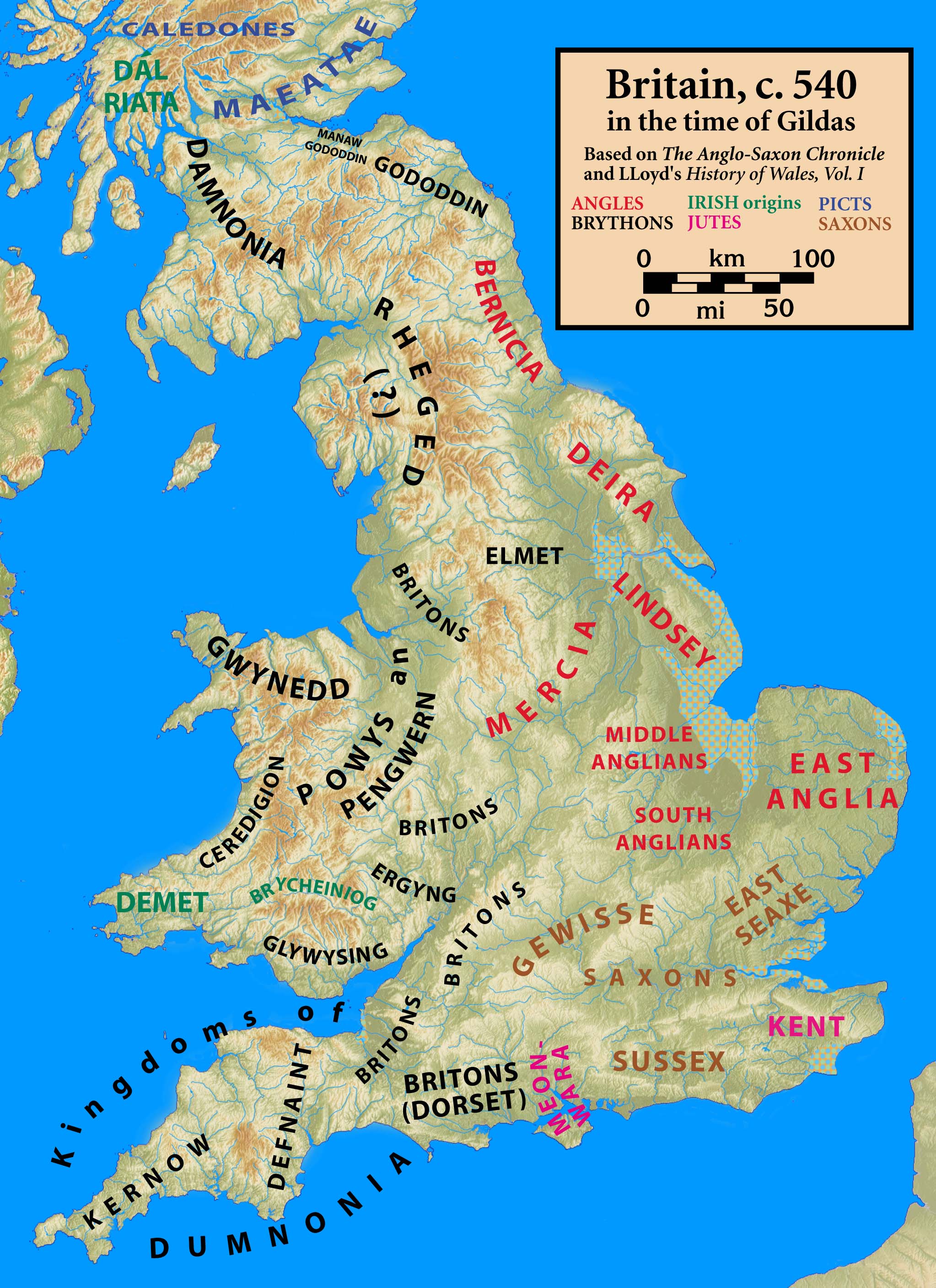
After the great city of Troy fell to Greek invaders, Aeneas, a Trojan prince, fled with his family to the distant land of Italy, and placed his hopes on a new destiny for his people, in a new country far from the smoldering ruins of his homeland.  Those of his descendants who remained in this new land would live to fulfill that destiny, in the founding of the city of Rome.  But not all would remain in Italy.   A child was born in the new royal household of the Trojans, his father a prince named Silvius, his mother a niece of Aeneas’s wife, Lavinia. Before his birth an oracle predicted that he would cause the death of his parents, and that after wandering in exile he would someday rise to greatness.  The oracle’s unsettling predictions would prove to be true all too soon: the child’s mother died in giving birth to him, and when he reached his teens, a tragic accident with a bow and arrow would leave his father dead, an unintended victim of his deadly aim.  Being cast out of Italy by his angry relatives, the young man traveled to Greece, the land of his ancestor’s enemies, and there found that many Trojans were living in bondage, suffering slavery as the final humiliating price of their defeat.  The young man rallied his kinsfolk to revolt, and although his band of ex-slaves was greatly outnumbered, in a final assault against the king’s armies that was as cunning as it was bold, the Trojans massacred the Greek forces, and took the king himself as hostage.  In return for his freedom, the king offered the young man his own daughter’s hand in marriage, and a fleet of ships with which the Trojans could find freedom in a new land, far away from the bitter and vengeful malice of the Greeks.  In a dream, the goddess Diana told the young Trojan to take his ships westward, beyond the setting sun, to an island in the sea that had once been occupied by giants.  She promised him that the new land would be a second Troy, that he would father a race of kings there, and that its kingdom would one day have dominion over peoples and countries spanning the entire world.  The man was named Brutus, and the island that he and his followers settled upon would bear the stamp of that name.  It was called Britain, in his honor, and true to Diana’s prediction, his descendants would reign as kings over a nation that would someday hold the entire world in its sway.  But long before Britain would make its mark in the world, the relatives of Brutus in Italy would create their own empire based in Rome.  And after centuries of rule, as the empire of Rome began to shake and totter in the face of German invaders at its outer reaches, a young king in Britain would make his own stand against these invaders, facing them in a series of desperate conflicts on the island itself.  While the Germans would eventually carry the day, the heroism of this British king and his fellow warriors in holding them back would become the stuff of legend - the legend, in fact, of King Arthur.


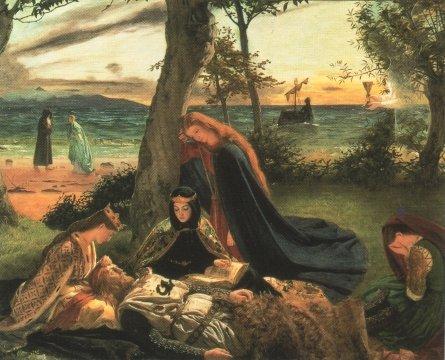
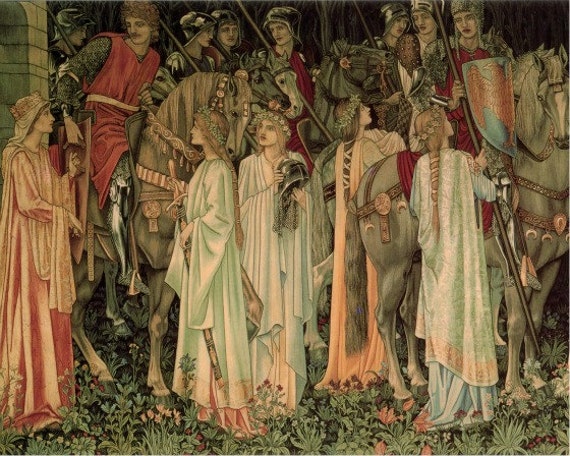
            Of all of the legendary heroes of history, Gilgamesh, Theseus, Achilles, and Moses, there is probably none who has been more romanticized, and whose story has been so often retold in so many different ways, than King Arthur.  This fabled ruler of Britain, who was supposed to have lived in the late fifth or early sixth century, still has throngs of devoted fans to this day.  And in many respects the legends about the manners and traditions of his court made him and his fellow knights, with their code of chivalry, “role models” for European courtly life centuries later.  But did King Arthur really exist, and if so, what part of the legend is based in fact, and what is just poetic fancy?

            To understand the role that a historic Arthur would have played in Britain, around 500 A.D., we have to return to Rome, and trace its fate after the rise of emperor Constantine and his establishment of Christianity as the official religion of the empire.  In fact, the reign of Constantine in the early fourth century marks in many ways the beginning of the fall of the Roman Empire, a connection that would not be lost to many pagans who would later link the rise of Christianity with the fall of Rome.  Besides the establishment of a new official religion, Constantine also introduced another major change to the empire: he moved its capital from Rome to a new, more central location in Byzantium, in present-day Turkey.  By the end of the fourth century, the empire would be permanently divided, between an eastern one with its capital in Constantinople, the city founded by Constantine, and a western one with its capital still in Rome.  And in 410, Rome would be overrun and sacked by barbarian invaders led by Alaric, king of the Visigoths.  This disaster was the signal event that prompted many pagans to declare that the traditional gods were punishing the people for deserting them, and adopting the strange, new faith of Christianity.  The charge would inspire the famous Christian bishop and early Church father, St. Augustine, to write a book called The City of God, which was his defense of Christianity against the pagans.  The pagan gods, he contended, with their amoral and fickle ways, were never worthy of allegiance to begin with, as was the moral god of the Hebrews.  And in his book, Augustine actually refined the argument of St. Paul that a spiritual allegiance to God does not necessarily contradict an allegiance to an earthly state, and that Christians, with their otherworldly aspirations, were no threat to the safety of Rome.  But he went further, saying that the earthly city of man will pass away, but the city of God is eternal, and to find membership in it should be the most important hope and concern of any human being.  In fact, the city of Rome recovered from Alaric’s attack, but its salvation was only temporary.  In 476 it would see its last emperor, Romulus Augustulus, surrender the throne to a rebel German general, who in turn surrendered it to the Ostrogoths in 493.

The Sack of Rome by Alaric's Visigoths: 410 AD

            The empire had actually been under siege for centuries, contending with barbarian invaders attacking from many fronts.  Around 100 B.C., the Roman general Marius fought off an attempted invasion of Italy by the Cimbri and the Teutons, and in 50 B.C. Julius Caesar fought and subdued the Suevi in Gaul.  The Goths, who had originally come from Sweden, plagued Rome and its holdings as early as the third century A.D., when they plundered the city of Athens and then threatened Italy itself over the next one hundred years.  Around 370 A.D. the Goths split into two separate tribes, the Visigoths and Ostrogoths, and it was the Visigoths who would, after invading Greece, turn their wrath upon Rome in 410.  The Vandals were another persistent enemy of the empire; in 439 AD they took over Rome’s holdings in Africa, and looted and plundered ships sailing in the Mediterranean Sea, linking their name forever with random acts of violence and destruction.  And from the east, the empire faced the wrath of the Huns, an Asian horde, who under their famous leader Attila attacked Gaul and Italy, beginning in 451 AD.  In their expedition against Gaul, the Huns enlisted the aid of the Ostrogoths and Vandals, but were resisted by the combined forces of Rome’s legions and the Visigoths.  The battle that ensued was one of the bloodiest in ancient history, and although Attila and his forces lost, he returned a year later to threaten Rome itself.  It was only a personal appeal from Leo the Great - bishop of the city - that saved it from being sacked again.  A similar appeal from the bishop three years later would spare the lives of the Roman people from an attack by the Vandals, but he could not spare the city itself from being plundered by the barbarians.  And in 477 AD, the Vandals attacked the city again, which by then had already fallen under the control of barbarian rebels.  But it was the Ostrogoths, under the leadership of Theodoric, who would eventually bring Rome and the entire Italian peninsula under their rule in 493, the year that marks the end of the Roman Empire in the west, and the beginning of the Dark Ages for Europe. 

     
            Who were these Germans, that brought an entire empire to its knees?  To the Greeks and the Romans, they were uncivilized savages, and their strange customs were both fascinating and terrifying to the citizens of the empire.  While a good Roman wife, for example, might bear one or two children for her husband, it was observed that the German wife would have several, and it soon became apparent that while the Roman population was barely maintaining itself, the German population was exploding.  The German men were renowned for their savagery, but so were the women.  It was a popular belief that a German warrior, retreating from a battle, would have to face the vengeful and possibly deadly wrath of a wife who had been shamed by his cowardice.  For such a soldier, it required less bravery to stay on the battlefield than to leave it.  And while the Greeks and the Romans enjoyed wine as their drink of choice, the Germans preferred a bitter-tasting alcoholic beverage which they called “ol” (ale) made from fermented barley or wheat and other herbs.  It was reported that in nightly gatherings, when the men enjoyed drinking large quantities of this brew, what would begin as an orderly social event would descend into an out-and-out brawl.  This must have been shocking behavior to the wine-drinking Greeks and Romans, whose own drinking parties would produce only spirited, invigorating conversation, or in the most extreme cases, perhaps an orgy.  The growth of population, and the pressure of other migrating hordes from beyond the empire, continuously impelled the barbarians to search for new land to occupy, and when the Romans realized that they could no longer keep them out, they tried to find ways to use them, or at least to control them.  Barbarian tribesmen were inducted into the legions as auxiliaries, and veterans were rewarded with grants of land within the empire.  It was a practical, but ultimately shortsighted, solution to contain the German menace.  Ironically, after Rome fell to the barbarians, it was probably one very subtle but important thing that caused the Germans to ultimately become preservers rather than destroyers of much of Roman culture.  By the time they had overrun the empire, they had themselves been overrun by the message of St. Paul.  They had become Christians.


Gothic Warriors


            The island of Britain had been inhabited, in prehistoric times, by a people called the Picts, who in turn endured waves of invasions by another people known as the Celts.  It was Julius Caesar who first attempted to bring the island under Roman rule, in 54 B.C., but it was not until nine years later that it became an imperial province.  And resistance to Roman domination continued, prompting the Roman emperor Hadrian to construct a 70-mile wall across the island, to keep the most violent rebels, the Caledonians, north of the wall in Scotland.  For two hundred years, the Britons lived peacefully as subjects of the empire, benefiting from the technological advances and cultural influences bestowed upon them by the Romans.  But by 300 A.D., as the empire faced mounting threats in other regions, its legions began to pull out of Britain, and when Rome was sacked by the Visigoths in 410, its armies withdrew completely, leaving the islanders to fend for themselves.  Over the next two hundred years, the civilization established by the Romans in Britain disintegrated, while the islanders had to contend with their own hordes of Germanic invaders, the Angles and the Saxons.

            The earliest historical records of what actually happened in Britain during that time are very scarce.  We know that in 410 A.D. – the same year that Rome was attacked by the Visigoths – the Britons appealed to the empire for help in holding back an invasion of the Saxons.  Rome’s reply was that the Britons would have to defend themselves, and apparently they did.  The Saxons were repelled, but only for a time.  More appeals to Rome for help against the barbarians came during the years 430 to 454 A.D.  After that time, local princes on the island made the problem even worse when they hired Saxon mercenaries to protect their interests.  Flooding that occurred in the Saxons’ European homeland prompted them to seek a new place to settle in Britain, but they did not stay content in the plot of land given to them by their overlords.  In the violent conflict that ensued, the Britons would rally behind a local hero to save them from the invaders.  In the great battle of Mount Badon, which happened around the year 485, this hero rallied his people to a great victory over the Saxons, and as a result of this victory the German invasion was held off for another fifty years.


            But who was this hero?  The earliest surviving account of this conflict with the Saxons, written by a man named Gildas in 540 AD, says that the champion of the Britons was one Ambrosius Aurelianus.  Gildas never refers to this man as a king, but does say that he had Roman ancestors.  Two hundred years later, Saint Bede, a historian, also described the battle of Mount Badon and identified Ambrosius as its hero, now a king.  Arthur’s name, and his link with the battle, first appears around the year 800, in a history called The Annals of Wales, and some years later in an account by Nennius called the History of the Britons, in which twelve battles against the Saxons are described, under the leadership of Arthur in alliance with the kings of Britain, the final battle being the one at Mount Badon.  In the Cambrian Annals, written by an anonymous Welsh writer around 950, Arthur is again mentioned as the victor at the battle of Mount Badon.  This account goes on to describe the death of Arthur and one Medraut at the Battle of Camlann in 537.  And finally, in William of Malmesbury’s Exploits of the English Kings, written in the early twelfth century, the names of Ambrosius and Arthur appear together.  Arthur is credited with assisting Ambrosius in his victory over the barbarian invaders, and is also honored for his victory at the battle of Mount Badon.

Arthur at the Battle of Mount Badon

            But while Arthur’s name shows up relatively late in the historical accounts of Britain, he had apparently become a folk hero among the Welsh and other Celtic peoples of Britain very early on, appearing in poems, ballads, and tales that were recited by the natives and passed on from generation to generation.  Already in these accounts, Arthur has a supernatural aura, and the tales of his exploits are tinged with magic.

            In 1139 A.D. the Arthur of history and the Arthur of legend were thrown together for the very first time in Geoffrey of Monmouth’s Histories of the Kings of Britain.  Geoffrey claimed that his history was a translation of an earlier work written in the Welsh tongue, but evidence of that earlier work has never been found.  And like Plato’s story of the lost land of Atlantis, Geoffrey’s history was regarded by many as a tall tale, even in his time.  Nevertheless, it enjoyed wide popularity after its publication.  Geoffrey himself was of Celtic descent, and in an age in which Celtic pride was reasserting itself, the story of Arthur’s valiant defense of Britain against the German invaders, whose descendents in Britain now treated the Celts with condescension, must have struck a sympathetic chord.  What’s more, the island had fallen to foreign invaders in recent times once again.  In 1066, less than one hundred years before the publication of Geoffrey’s history, Norman invaders from France, under William II, conquered the land and established William as its new king.  It’s probably no coincidence that Geoffrey traced the history of Britain’s early rulers back to the Trojans, since Norman royalty believed that their own ancestry also had ties to Troy.

            Geoffrey of Monmouth gives us the first full-blown account of the story of Arthur’s life, complete with Merlin, Guinevere, and Mordred, an enchanted sword, and many of the other features of the Arthurian legend that would survive in all later versions.  In his story, the direct line leading to Arthur begins with Constantine – not the Roman emperor, but a nobleman who was called upon to lead the Britons as their king and protect it from barbarian invaders after Rome abandoned the island.  Constantine rallied his people to victory against the barbarians, but was assassinated soon afterward by one of their spies.  After his death, the oldest of his three sons, Constans, was set up as a puppet ruler by the evil Vortigern, who pretended to be a trusted counselor to the young king, but secretly wanted the crown for himself.  Vortigern had Constans assassinated, and rose to the throne, but then he made a fatal mistake.  In an effort to secure his tenuous hold over the island, Vortigern enlisted the aid of the Saxons, and invited them to send soldiers to his kingdom and even to settle there.  Vortigern would come to realize that the Saxons were not his protectors, but his conquerors, and that he was in imminent danger of losing his own life at their hands.  In desperation, he consulted his magicians for advice on how to protect himself from the invaders, and they advised him to build a strong tower where he could flee and find refuge if all of his other fortresses fell.  But when his masons found that they could not establish a foundation for the tower at the site that he had chosen, because with each attempt it would sink into the earth, Vortigern consulted his magicians again.  This time they advised him to seek out a boy who had no father, and to make of him a human sacrifice whose blood, when sprinkled on the mortar and the stones, would make the foundation firm.  Messengers were dispatched throughout the kingdom to find such a boy, and after searching the island, they produced one, whose mother was the daughter of a king, but who apparently had no earthly father.  His name was Merlin.  But Merlin proved to be more than a match for the magicians who had called for his death.  After being presented to the king, Merlin so impressed him with his knowledge and his boldness that his life was spared, and he was retained as a court prophet, although his prophecies did not bode well for Vortigern.  Merlin predicted that Vortigern would soon face vengeance at the hands of Constans’ two younger brothers, Aurelius Ambrosius and Uther Pendragon, and the very next day Aurelius arrived on the shores of Britain and rallied the people to his cause.  Vortigern fled to a tower, but died as the forces of Aurelius set it to the torch.

Image result for stonehenge
Stonehenge: A Gift from Merlin?

            After driving off a large remnant of the Saxons on the island, and subduing many others, Aurelius sought to erect a monument to commemorate the bravery of his soldiers.  He sent for Merlin, and the young wizard told of a ring of huge stones in Ireland, used for religious rites, which had magical properties.  The stones had been moved to Ireland from Africa by a race of giants many years earlier, Merlin explained, and now he proposed to bring them into Aurelius's realm.  Aurelius had laughed at Merlin as he began to recount this story, but he would later discover that this was no idle tale.  Merlin recovered the stones, astonishing the men who accompanied him to Ireland as he lifted them effortlessly with the aid of his magic, and later set them up at the site chosen by Aurelius in Britain, the site that is known as Stonehenge today.  Aurelius Ambrosius soon met his own end after falling ill, when a Saxon spy, disguised as a doctor who had come to treat the illness, poisoned him.  The crown of Britain now passed on to the youngest of Constantine’s sons, Uther Pendragon.

            Uther continued his brother’s rout of the Saxon enemies, winning a decisive victory at the Battle of Mount Damen.  But in a victory celebration in the town of London, Uther’s courage and heroism would give way to baser instincts.  One of his allies in the battle had been the Duke of Cornwall, and at the celebration, Uther became enthralled with the Duke’s wife, Ygerne, showering her with admiration and unseemly attention.  The Duke, annoyed at this spectacle and fearful that he would lose his wife to the covetous desires of the king, withdrew from the court in the company of his wife.  Enraged at this insult, Uther collected an army and pursued the Duke back to Cornwall.  The Duke, who was more concerned about his wife’s safety than his own, put her up in Tintagel castle, which seemed to be impregnable to outsiders.  And Uther, unable to restrain the passion that he had for Ygerne, appealed to Merlin to help him find a way to reach her.  Through Merlin’s magic, he assumed the appearance of the Duke, and gained access to Tintagel castle, and to Ygerne.  The real Duke met his death at the hands of Uther’s armies in another castle, while in Tintagel, Ygerne believed that she had been reunited with her husband.  It was during this time that Uther and Ygerne conceived a child, the future King Arthur.


            Uther Pendragon would meet his own end the same way that his brother Ambrosius had, through poisoning at the hands of Saxon spies.  At the news of his death, the Saxons who had remained in Britain urged their relatives from Germany to join them, since they believed that with the king gone there would no longer be a champion to rally the Britons in defense of the island.  In desperation, the bishops bestowed the crown upon the king’s son, Arthur, though he was only fifteen years old.  He proved to be a more than worthy successor to his father.  With his sword, Caliburn, forged in the Isle of Avalon, he led the fight against the Saxons, until they were again driven off the island.  But Arthur did not settle for defensive victories.  After marrying Guinevere, a noblewoman of Roman ancestry, he led his armies in wars of conquest against Ireland, Iceland, Gaul, and eventually in a war of revolt against Rome itself, after emissaries of the empire demanded that Britain resume paying a tribute to the empire that had been levied against it since the days when Julius Caesar ruled.  Although Arthur’s army would be victorious in this war against the empire, the victory would yield the seeds of his own doom.  For while he had been away on the continent, his traitorous nephew Mordred, in whom he had entrusted the care of Britain, had entered into an adulterous affair with Queen Guinevere, and had declared himself king.  Arthur returned with his army to face Mordred, who had enlisted the aid of the Saxons, Irish, Scots, and Picts in his cause, and the two opponents met at the River Camlann in 542 AD, where Mordred met his death, and Arthur was mortally wounded.  Arthur passed the crown on to his cousin Constantine, and was carried off to the isle of Avalon, to be treated for his wounds.

King Arthur, Mortally Wounded

            That’s it – the earliest written account that gives us a complete story of Arthur’s origins and accomplishments, by Geoffrey of Monmouth in 1136 AD, nearly a thousand years ago.  Geoffrey’s version, in addition to giving us the first fully formed story of Arthur’s life, also introduces other features of what would become the Arthurian legend.  We are told that his knights were famed for their bravery, and descriptions of his court are livened by the simultaneous spectacle of pomp and ceremony, religious devotion, and military tournaments.  Courtly love finds its first expression in this tale, as the women of noble rank only show affection to knights who prove themselves in battle.  And many of the knights who would be immortalized in all of the later Arthurian stories appear here, such as Arthur’s nephew, Gawain, and Sir Kay.   But other features of the legend would only arise in later accounts, such as Merlin’s role as Arthur’s tutor, the sword in the stone, the round table, Arthur’s evil sister, Morgan le Fay (who in earlier versions was merely a healer and enchantress unrelated to Arthur), and many of his other principal knights, like Lancelot, Percival, and Galahad.  About half a century after Geoffrey’s history of Arthur appeared, the lyrical poems of French writer Chrestian De Troyes would add color and substance to the tale.  In these poems, we learn of the knights’ quest for the Holy Grail, the cup that Christ drank from during the Last Supper.  And in these poems we find the tragic love triangle between Arthur, Guinevere, and Arthur’s trusted knight, Lancelot.  Two hundred years later, in 1485, the legend would find its fullest expression in Sir Thomas Malory’s Le Morte D’ Arthur. 

Knights of the Round Table

            In many respects, the saga of King Arthur and his battles is not unlike the saga of the Trojan War, in which Greek forces fought valiantly against a foreign power that dared to offend their honor.  Both of these sagas seem to have a basis in fact, alluding to real conflicts that occurred in the distant past, that have been embellished and glossed over with mythic and supernatural imagery, exaggerated deeds of valor, and struggles of literally epic proportions.  But in the case of Troy, while we know that the tale survived in poems or songs that were recited over succeeding generations, it is only the final version of these retellings that has survived, as two epic poems, the Iliad and Odyssey, supposedly composed by a person who may be semi-mythical in his own right: the blind poet Homer.  So we can never tell exactly where history ends, and fantasy begins, except by looking at archaeological ruins to get a hint of what may have actually occurred.  In the case of Arthur, however, we can get at least a sense of what part of the legend is based on facts, and what part on myth.  The earliest historical accounts all seem to agree that a great battle, or series of battles, occurred between the native Britons and invading German tribes around the time that Arthur supposedly lived.  And while Arthur’s name does not appear in the earliest versions of these accounts, it does appear very early on in Welsh poems.  Geoffrey of Monmouth almost certainly relied on the earlier histories for his own version, and it is very likely that he drew from these Welsh poems, as well as other native legends or tall tales, for the more fanciful part of his story.  The other heroes and events of Arthur’s tale probably came from a variety of sources.  Both Mordred and Merlin appear in histories older than Geoffrey’s; and in an account written by Nennius around 800 A.D., while Merlin’s mother claims that her child has no mortal father, Merlin himself says that his father was in fact a Roman consul.  Many of the knights who appear in the court of Camelot were probably introduced from other folk religions or legends: Gawain, for example, a Celtic sun god, Lancelot, a Gaelic sun god, and Parsival, the Welsh hero Peredur; and Arthur’s evil sister, Morgan le Fay, could be an incarnation of the Celtic war goddess, Morrigan, or the Welsh mother goddess, Modron.

            What is it about Arthur’s legend that makes it so compelling, and so fascinating to readers and listeners, even now, some fifteen hundred years after this hero supposedly lived?  What is the source of its power, and what has been its relevance to the generations that continue to preserve it?  A key to this question’s answer is the reality of life, both in Arthur’s day, and in the days of those who chronicled his life.  We know that in the years preceding Arthur’s birth, the empire of Rome collapsed, succumbing to waves of Germanic invaders, just as the island of Britain itself was fending off incursions from the Angles, Saxons, and Jutes, German tribes that were endeavoring to establish a new homeland there.  In the centuries that followed, the conquering Germans established kingdoms of their own on the ruins of the Roman Empire.  One of the most notable of these was Charlemagne, who was crowned as Holy Roman Emperor by the pope in 800 A.D.  The fact that Charlemagne allied himself to the Pope is a testament to the fact that the one institution which survived, unscathed, after the fall of Rome, was the Christian Church.  Every other relic of the great Roman civilization crumbled, sending Europe into a time called the Dark Ages, or the Gothic Era, as it was contemptuously labeled by Italians centuries later during the Renaissance.  The Roman roads, which had criss-crossed the European continent, fell into disrepair, and the great cities went into decline.  Agricultural productivity also declined, as fields and estates fell into the hands of local kings, who bestowed them upon powerful nobles as rewards for faithful service.  These “nobles” were little more than well-armed thugs, who treated the serfs who worked their lands with contempt, and offered them only a share of the food that they cultivated for their overlords.  But by the time of Geoffrey’s age, in the twelfth century, towns and cities began to re-emerge as centers of commerce, farming techniques were improved, and roads were reconstructed.  Serfs were actually able to accumulate some wealth, and a rising commercial class came into existence.  Meanwhile, the nobility developed a new sense of social pride, based upon ancestral lines, and a code of conduct, called chivalry, that defined their relations with each other, with women, and with the other members of their society.  Chivalry literally means “horsemanship”, and the code had a particular bearing on the behavior of the warrior class, the knights, demanding that in addition to bravery they exhibited a gentle personality towards those with whom they came in contact.

The Gallantry of Medieval Knights

            By Geoffrey’s time, much of the land of the Britons had become the land of the Angles – “Angle-Land”, or England – and it had been ruled by Saxon kings for over two hundred years until a new wave of invaders, the Normans, conquered the island in 1066 AD.  And although Geoffrey and his fellow Celts might have taken some satisfaction in this, seeing in it a turning of the Wheel of Fortune as the old invaders were overrun in turn by new ones, for the Anglo-Saxons, the event must have been seen as catastrophic.  It is ironic, then, that they probably drew a different sort of inspiration in Arthur’s story.  Just as the ancient Sumerians, after seeing their land conquered by Sargon, took heart in the story of their ancient hero Gilgamesh, and the Hebrews, during their times of troubles, found comfort in the stories of Moses and King David, so the English could look back to the ancient hero Arthur, who so valiantly defended their land against an earlier wave of conquerors.  But the irony, of course, is that these enemies of Arthur were their own ancestors, the Germanic invaders now permanently established on the island.

            The story of Arthur and his court also has another parallel to a legend that we have looked at: the story of the ancient kingdom of Atlantis.  Here again we see the yearning to believe that there was a golden age, half-forgotten in the distant mists of the past, where a society reached the summit of power and glory before a tragic downfall.  And like Atlantis, Arthur’s kingdom was like a beacon, guiding those of later generations who revered it on a path of return to glory.  While chivalry and courtly life in Arthur’s era may have been a myth, it became a reality in Europe by the twelfth century, defining a code of conduct for the warrior class that was supported by the Church, the one institution that had survived the catastrophes which had befallen the old Roman Empire.  The religious mysticism that permeated so many of the Arthurian tales, in particular those involving the quest for the Holy Grail, inspired the Christian population, both rich and poor, to find meaning in their lives through devotion to a higher ideal, continuing a trend to greater piety that had already been underway in the centuries after Arthur’s death.  But as the growing power of the Church led to internal corruption, and conflicts with the secular power of the European kings, the religious zeal of the general population began to express itself in new and unconventional ways.  The Church itself tried to harness this religious devotion to attain very worldly ends, as a weapon against kings who dared to challenge its power, and against foreign enemies, through the launching of Crusades.  But there were other enemies that would soon occupy the energies of the Church – the pagan, the heretic, and the witch.